28 April, 2011

Land Ho!

Date: April 28, 2011
Position: N 24 34.175 W 081 48.206
Location: Key West, Florida, USA

Our last 2 days have been busy and tiring. We slogged along the north coast of Cuba for a day and 2 nights, into the wind, which is never fun. However, there were times of reprieve when the winds died down and made the ride a little more comfortable. Our plan was to head for Miami ahead of some bad weather this weekend, but after checking the weather this morning we saw the wind was expected to shift more easterly. This meant 2 more days of close hauled sailing into the wind and waves. Suddenly Key West was looking much more attractive!!

We turned Rachel toward Key West and immediately she rode the waves better, sailed faster and more easily, and we all felt much happier.

About 50 miles off Key West we got a call on the VHF radio from the Coast Guard. They asked for basic information about the boat and told us to stand by. About 5 minutes later they call back and say they'll be sending a boarding party to do a 'safety check'.

US Coast Guard cutter

A pretty good sized Coast Guard cutter suddenly comes into view, they lift a big inflatable into the water off the side deck, 4 officers get into it and they head toward Rachel. While we are still sailing 3 of them jumped aboard Rachel to do our safety check. Everything went really well, they were very professional but friendly and after about 30 minutes they were on their way. We told them it was so nice to talk to someone other than each other and they got a chuckle out of that!! Apparently the Coast Guard cutter had been 300 yards off our boat while we were sailing along the Cuban coast last night, we had never seen them (even using our radar!!), and neither did Osprey, our travel companions.

30 miles from Key West a pod of dolphins came to play with us. About 15 of them swam in front of the boat doing tricks and leaping out of the water. What a lovely welcome back!!

20 miles from Key West we started seeing a lot of port traffic and hearing LOTS of chatter on the radio. All vessels with a VHF radio are required to monitor channel 16. Unfortunately, there is so much yakking on that channel that we looked at each wondering why we came back. We couldn't even have a conversation with each other without interruption. The constant chatter really got on our "last nerve". We'll take a dolphin welcome, any day!!

Despite the constant interruptions we managed to communicate with each other and slowly work our way into Key West harbor in the dark. We anchored at 9:30 pm and are safe and well. Tomorrow we have to figure out how to check in to the US here. Until then it's a good nights sleep for Rachel's crew. And we get to sleep at the same time for the first time in 10 days!

It's good to be back. Good Night

25 April, 2011

More plan changes

Position: N 20 13.427 W 85 58.843
Location: Heading for the Yucatan Channel

Yesterday was an uneventful day except the seas were rolly and not too comfortable. In the evening Julie was sitting in the cockpit on night watch looking up at the stars when she felt a flutter near her cheek. She turned on the flashlight and there was a dove sitting on the cockpit floor. We were 120 miles from land to the west and northwest, poor thing must be tired she thought. Not too happy about it pooping all over, she shooed it to the stern of the boat and it fluttered again landing underneath our solar panel. There it sat for most of the night and when we looked this morning it was gone!!

After downloading the weather this morning and talking to our weather guy we, along with Osprey, have decided to keep on going, heading to the Dry Tortugas off the Florida Keys (or perhaps further), if the weather holds. Our other 2 friends kept on going to Isla Mujeres so now we are a fleet of two!

Stay tuned.

22 April, 2011

Cayos Cajones

Position: N 17 54.573 W 84 38.792
Location: Caribbean Sea

Well we just spent 1 1/2 lovely days at the Hobbies Cays (Cayos Cajones), tiny islands sitting behind a reef in the middle of nowhere. The small island next to which we were anchored had 2 young Honduran guys living on it. They said they were there for a month and as far as we could gather they were caretakers and guards for the hundreds of lobster pots piled all over the island. One of them, Federico, paddled out to our boat and asked if we had cigarettes and we had a nice chat in our pidgin Spanish.


The snorkeling and fishing around the reefs here is reportedly amazing, that's the main reason people stop here. We did manage a snorkel yesterday which was awesome and yesterday afternoon had a happy hour gathering on a tiny beach island by the reef, surprisingly there were 7 boats anchored here.

Baracuda caught on our way into the anchorage

Saturday, April 23, 2011

After listening to yesterday's forecast we all decided it was time to head further north before some stronger winds settle in on Tuesday, so this morning we hauled anchor at 06:15 and continued our journey to Isla Mujeres, Mexico. So far it's a bit rolly but the sun is shining and the fishing line is out. Today is our 4th anniversary living aboard Rachel, it keeps getting better. As the sun set we sat in the cockpit eating a special dinner with sparkling water!! We were rolling still pretty badly but the rolling allowed us to see 2 green flashes one after the other as Rachel rolled gunwale to gunwale. Good AND Bad
A quiet night, we saw no ship traffic.

Sunday, April 24, 2011

The four boats who set out together from the Hobbies for Isla Mujeres (Osprey, Tashmoo, Mentor, and Rachel) all seem to be fairly well matched - we're all still within about 8 miles of each other, making it possible to have nice chats on the VHF radio during night watches. It's nice to hear friend's voices during those dark hours. It's been very rolly with light winds and big waves - not one of our favorite 24 hours of passage making, that's for sure. Everyone has had trouble sleeping. We're hoping to get things a bit more stable during the day today and see if we can catch up on some sleep.
Adendum - since writing this the other 3 boats have sprinted ahead of us, we're still in VHF range with 2 of them though

Change of plans (go figure...)

Location: Cayos Cajones, Honduras
Position: N 16 01.837 W 083 06.199

Wow! Talk about on the edge of nowhere! The Hobbies Cays (Cayos Cajones) is on the edge of nowhere!! Really! It's probably the most remote place we've ever been. We're sitting here looking out at the Caribbean Sea with nothing between us and all those waves but the reefs that surround these small, low cays. It's amazing.

Oh. We guess we should tell you that this morning we decided at the last minute to stop at the Hobbies to wait our some less-than-excellent weather that was expected over the next few days up near Isla Mujeres. Our friends on Osprey and Tashmoo, whom we are traveling with, stopped also. Funnily enough there are 3 other boats already here and we already know 2 of them from Honduras! Small world eh? We've heard there's great snorkeling here so that's what we'll be doing for the next couple of days.

It's amazing. We came in here at around 3pm today. It happened to be only a few miles out of our way, anyway - what could be better? When we dropped the anchor we were amazed to find an absolutely flat, calm, yet breezy anchorage on the edge of the shelf that extends all the way out here from Honduras. This after bouncing around for almost 4 days getting here! We're sitting here with only the barrier reef between us and the Atlantic Ocean and it's FLAT! This is so cool!

On the way here we hooked a 4' mahi mahi, but it got away as we were bringing it alongside the boat. DANG!! Images of delicious fish dinners reluctantly begin to fade ..

Then, just as we were turning in and had to haul in the fishing line, we hooked a 30" barracuda! Talk about teeth..man, these things are toothy! We'd never eaten barracuda before, but on the advice of friends anchored here decided to try it. WOW! It's delicious - a nice white meat without the fishy taste other fish sometimes have. We had a wonderful dinner and are now ready for some well deserved rest & relaxation. A glass of wine and a rum drink, sitting out on deck, just soaking it all in...

Wow. So. Awesome. We're taking an unexpected, albeit welcome "pit stop" on our way north. Sometimes the best things just sort of "happen". What a cool life we have!

All our best,

Mark & Julie

21 April, 2011

San Blas to Isla Mujeres - Day 3

Position: N 15 34.252 W 082 36.641

We've had a great day 3 and got another 142 miles under our belts. We're currently 40 miles south of the Hobbies (Cayos Cojones), off the coast of Nicaragua - about half way through our trip to Isla Mujeres, Mexico. We had sun all day, winds on the beam at 8 to 10 knots, sailed almost all day, and only saw maybe one boat ALL day.

We're finally getting caught up on our sleep and starting to feel human again. It always seems to take until the second or third day for us to get acclimated to a passage. Not much happened during the day except for the 20 or so dolphins that came to play in our bow wake. As usual Julie ran up to the bow and spent a good 15 minutes watching them jump and play before they peeled off to play somewhere else. We had a lovely dinner in the cockpit, watched the sun disappear below the horizon, and were treated to a small green flash. The perfect end to a perfect day.

During the night we dodged a few squalls and enjoyed playing 'identify the cloud creatures' with the big black clouds in front of the majestic moon. "This one's a dragon with a lady on it's back." "That one is a man with a pointy nose and a big chin!"

We have to entertain ourselves as best we can!

Mark & Julie

20 April, 2011

Under way

Location: Just East of Providencia, a Columbian island off the coast of Nicaragua
Position: N 13 39.624 W 81 14.394

We're starting day three of our passage. We've just got the weather from our SSB radio weather guy, have downloaded the latest GRIB (wind and wave forecast model) files, and it looks like we'll have great weather to make Isla Mujeres, Mexico.

Our first day we had winds on the nose and boisterous seas, 5 - 8 feet, causing us to be a little uncomfortable. But we made good progress and after the first 60 or so miles, we were on a nice, fast close reach.

Our first night we got to see the Big Dipper pointing at Polaris, the North Star, off our bow, the Southern Cross off our stern, and a full moon above us. A fantastic display of three of our favorite stellar bodies. While we are sad to be leaving one of our favorite cruising grounds, and happy to be on our way back to family and friends in the US, we are also excited - this will be our longest passage to date on Rachel.

We've seen lots of big ship traffic heading toward and away from the Panama Canal, making watch keeping a bit exciting at times. The wind shifted a little more east and the seas died down to only 3-6 feet making us more comfortable. We made 140 miles in our first 24 hours, good for us.

The winds and seas held through our 2nd day, this is always the hardest day as we could both use a bit more sleep, but sleep is coming easier as we get into the rhythms of making passage. The ship traffic was less today, lovely sunny skies and we saw 3 dolphins.

Through the night we again had great starlit sky and the full moon, just past, rose at 8:30 pm to help us through the night. We got more sleep so we're feeling a bit more human and the seas have died down to 3-5 ft. We made another 150 miles today, awesome.

All is well as we start on Day 3, we're happy and healthy, and are just passing Providencia, feeling nostalgic for the times we spent there over Christmas. Rachel is cranking along on a beam reach at over 6 knots in light winds. It doesn't get much better than this. The constant movement, the rush of Rachel's movement through the waves, the wind in the cockpit, the sounds of friends on the radios all begin to keep us awake less and less as we acclimate to being on passage.

Oops - it's 7:44 in the morning! Time for bed for one of us!

17 April, 2011

Adios San Blas!!

Position: N 09 32.786 W 078 53.731
Location: West Lemmon Cays, San Blas, Panama


After 3 wonderful months in the San Blas the time has come for us to say “adios” and head back to the US. The weather looks good for a departure tomorrow (Monday, April 18th), so unless something changes we'll clear out in the morning and start our voyage North.

We've really enjoyed our stay here and are a bit reluctant to leave. We'll miss this beautiful place and our wonderful friends, but it'll be nice to get back to our friends and family in the good ol' US of A, too. How strange it will seem to not need to speak Spanish while shopping...


We've spent the last few weeks exploring places we had not yet seen and saying goodbye to friends before we will leave here. We realize how much we would like to return at some point, as there are still hundreds more scenic spots that will just have to wait.


We are hoping to make pretty fast progress. As long as the weather cooperates we'll try to keep on moving. Three or four other boats will be leaving with us. Even though we probably won't be able to keep up with them, it'll be nice to be in radio range and have someone to chat with during those long night watches.


We'll be sending daily position reports so check the 'Where is Rachel now' link on the blog as it will be updated daily. We'll also try to get out a few short Khronicle posting to the blog along the way, too.

Hasta la vista.

02 April, 2011

Seahorse Quest

Date: March 26, 2011
Position: N 09 28.778 W 078 38.103
Location: Green Island, San Blas, Panama

We've just spent 2 glorious days snorkeling on the reef here in Green Island. The wind and seas have been down making the water crystal clear. The low wind and waves also allowed us to get around to the ocean side of the reef just north of the island. We had 2, 2 hour snorkels and the fish were abundant. We saw hundreds of fish including: a spotted eagle ray gracefully flowing by; a big turtle foraging on sea grass 10 feet below the surface; trumpetfish; cowfish; indigo hamlets; 3 varieties of angelfish; porcupinefish; trunkfish; and a 6 ft nurse shark. We've never seen so many fish in such a short amount of time, although we're still on a quest to find seahorses. What a great couple of days!

24 March, 2011

Paradise

Date: March 17, 2011
Position: N 09 35.059 W 078 41.092
Location: Naguarchirdup, Lemmon Cays, San Blas, Panama

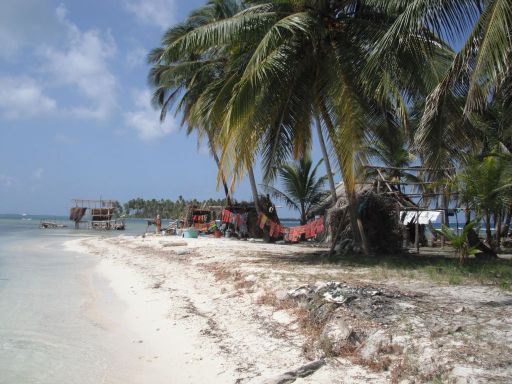
We have traveled almost 14,000 miles on Rachel and have finally made it to paradise. The San Blas , Kuna Yala to the locals - is the one of the most amazing places we have been to date. There are over 300 islands in this archipelago. Some are just a spit of sand with a palm tree or two, while others are almost half a mile long. And then there are the other hundreds that are in between. All are beautiful with swaying palm trees, white sand, warm breezes, and lots of beach treasures, a beach comber's paradise.

A beautiful island

One more beautiful island

Another island - are these getting boring?

OK maybe just one more lovely island

Most of the time we get to sail in clear blue waters behind coral reefs which means great wind for sailing without big ocean waves. With winds between 10 and 15 knots for the most part, it's not hard work, and everything is close enough together that we don't have to be in a hurry , we've been sailing a lot down here. After a few hours underway we pick a spot to anchor, sometimes amid a cluster of other boats, but more often away from the pack on our own. Some nights we are the only boat in the anchorage with our own private little island to explore. Nights have been mostly clear with millions of stars above, a sailor's paradise.

The waters between the islands usually run from 50 to 150 feet deep and are a beautiful dark blue. As we approach the islands the depth can go from 100 feet to 10 feet in an instant, requiring us to be alert and have good light so we can see the reefs and sand bars. We nuzzle up to a beach or sand bar, drop the anchor, and drift back into maybe 60 feet of water. This was a bit disconcerting at first but after a week or so we got used to it. Now Rachel is just a few hundred feet from the beach allowing us to easily swim ashore and walk around the islands. Sometimes we have to anchor a little further out but it's still easy to dinghy in, explore, and cool off with a relaxing dip in the water. Each island and chain of islands is surrounded by coral reefs, and also quite a lot of shipwrecks. This means exploring fish and coral heads to your hearts content, a swimmer's, snorkeler's, and diver's paradise.

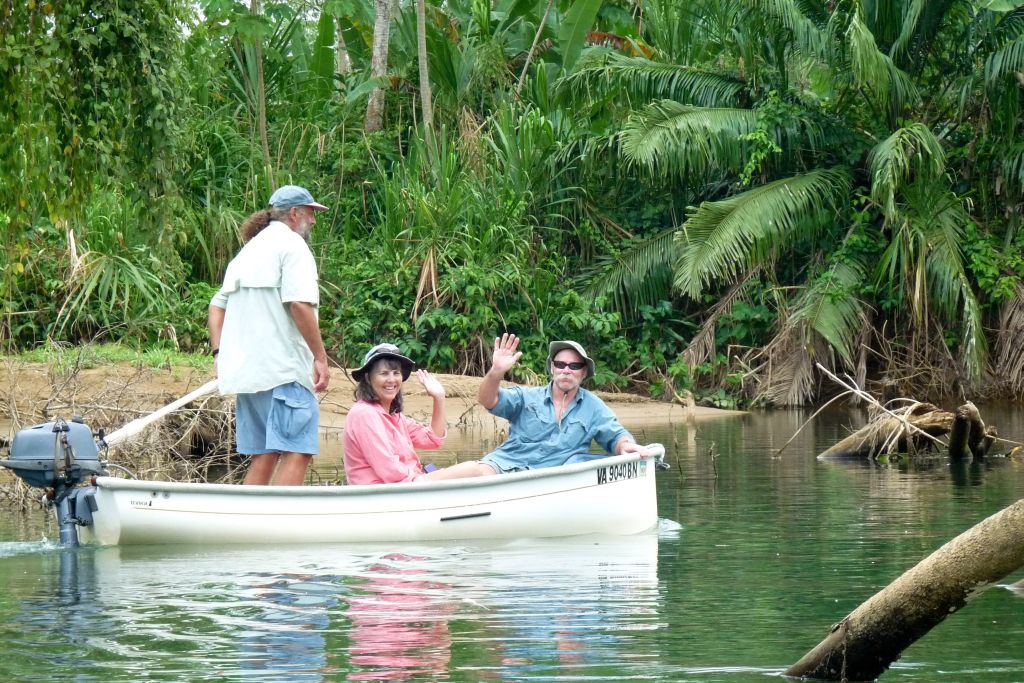
Dinghy trip into the jungle up the Rio Diablo with our visiting friends Shep and Deb

Many of the islands have one or two Kuna families living on them. They seem to rotate families on the islands, all seeming to come from villages on the mainland. We're not sure if this is work related, collecting coconuts, retaining ownership by habitation, or vacation for them. Whatever it is, they seem happy to be out here. At any rate, we're in the third world for sure - the Kuna live in dirt floor huts made from bamboo and palm fronds, and have very few possessions. Hammocks to sleep in, cooking and eating utensils, a few clothes, a machete, and usually a dugout canoe, called an ulu with paddles carved from boards and a sailing rig. Some very well-to-do Kunas have outboard motors for their ulus. So far we have found the Kuna to be honest, gentle, happy, and open, an anthropologist's paradise.

Isla Gerti, a very traditional island

Kuna settlement on Canbombia displaying molas for sale

Another Kuna settlement on Canbombia

Kuna settlement on the island of Tiadup

An old man carving a nuchu, a good luck statue displayed in many kuna huts

The standard mode of transportation in Kuna Yala is the ulu or dugout canoe. Sometimes they are paddled and sometimes they have homemade sails, often patchworked with any fabric they come across.

The men go out fishing every day and will often come around the cruising boats every afternoon selling their catch. Looking out from the boat we see them standing in their ulu wearing only underwear (their version of swimming shorts) with big grins on their faces, holding up a crab or lobster or fish, as if to say 'Look what I caught!'. We usually troll a fishing line when we move around so if we haven't managed to catch a fish we gladly buy from the locals at very reasonable prices - a seafood lover's paradise.

The women tend to stay on shore. They cook fish, bake bread, make molas, and bead. (Note: Google 'Kuna Yala mola' to learn more about molas). Whenever we go ashore on an island that's inhabited we politely ask permission to walk around. Permission is always granted. As the women see us approaching they scurry to get their bucket full of molas and arrange them for us to see. Julie had one of the women make her a beaded anklet, made to measure. It's one long string of beads that they wrap around and around and the beads line up to make a kuna design. Most of the local kuna women wear molas and sport these beads around their arms and legs. The molas and beads also make great gifts, a shopper's paradise.

Julie with Venancio 'Master Mola Maker'

Mola makers will paddle up to the boat and without a lot of encouragement they are on board showing their molas

Julie and our visiting friend Deb shopping for molas

The children sometimes get to go out fishing with the men or go out with women paddling an ulu around the cruising boats to sell molas or bread or they just play on the islands and in the water always laughing and enjoying life. Wherever we go the children appear around us smiling and saying "Hola!" (pronounced OH-la - Spanish for hello), and laughing and grinning when we say "Hola!" back to them. They almost always ask our names and will repeat them several times, we do the same with them. Sometimes we learn Kuna words from them like 'morbep' and teach them that it's 'conch' in English. Being so far from our grandchildren, we always enjoy spending time with the kids, a grandparent's paradise.

Some little boys on Canbombia 'helping' to sell molas

Anyway, it's time for us to get back to doing whatever it is we do. Today's a bit breezy so the wind generator is cranking out the amps. Thanks to the wind generator, the water maker is running, producing gallons of clear, fresh water from the sea without using any fuel. So it looks like we may get some reading done today. After lunch we just may take a nap. Or we might go snorkeling. 'Time and tide wait for no man' - no need for us to wait, we hardly ever know the time or the tide - the tide always seems to be less than a foot, anyway. You can tell we're really enjoying ourselves by this snippet of conversation from earlier this morning:

Julie: "What day is it today?"
Mark: "I dunno, maybe Wednesday or Thursday?"
Julie: "I'll turn on the computer. Oh! It's Thursday March 17th."
Julie, looking at the calendar: "Oh, it's St Patrick's Day"
Mark: "Happy St. Patrick's Day, sweetheart!"

Happy St. Patrick's Day from paradise,

03 March, 2011

Isla Tigre

Position: N 09 35.059 W 078 41.092
Location: Isla Tigre, Kuna Yala, Panama

The local indigenous people call themselves the Kuna. Their name for the San Blas Islands is Kuna Yala. Kuna Yala, while a part of Panama, is ruled independently by the Kuna general congresso. Recognized as an official reserve in 1938, Kuna Yala was granted full administrative and judicial autonomy in 1953.


No Kuna is allowed to marry a non-Kuna. If they do, they are expelled from Kuna Yala. While ensuring cultural integrity, it has also generated some genetic issues including albinos. They are a matrilineal society, the women control the money and the husband moves in with the wife and her family. Often, a woman will choose her husband rather than vice-versa.

Isla Tigre (pronounced EES-la TEE-gray) is an island, in Kuna Yala, a few miles off the Panamanian coast. On February 26, 1925, they, along with 6 other islands, rebelled against the Panamanian government. We are visiting the island to view and participate in their annual rebellion re-enactment and festival.


The first act takes place in the congresso (or town hall) with the Sailas (chiefs) swinging in their hammocks and chanting and the Argar (interpreter) translating the wisdom and putting it into perspective for the people who sit on hard wooden benches. Before the reenactment begins, we are given a brief history in English. In brief it goes like this:


The Kuna were happy living their traditional lives on Isla Tigre. One day a Panamanian school teacher approached them to ask about starting a school on the island. The sailas (chiefs) declined permission and the teacher was asked to leave. Some time later he returned with several Panamanian police. Using force, they imposed their will upon the people. They began a program to stamp out Kuna traditions that form the very heart of the people. Many traditions were outlawed and the participants were beaten and put in jail. They forced Kuna women to dance with them, this angered the men. They forced the children to go to their school.


The police celebrated carnival on February 25th. The rebellion was scheduled for the 25th because the police would be drunk making them easier to attack. During the rebellion two men were killed. One was a Panamanian police officer and one was a Kuna police officer who was viewed as having betrayed his people. After the rebellion the Panamanian government mounted a military campaign, and only intervention by the US Navy prevented bloody retaliation.


As the narration continues, the congresso slowly fills. The sailas lie in their hammocks, singing and greeting the people who arrive in ones and twos. Everyone is happy. Everyone is wearing traditional clothes. Then the school teacher arrives. There is discord in the congresso. The school teacher leaves, then returns with the police who start pushing people around and beating them. That's the end of act one. We are told there will be an intermission before the start of act two.


We go outside to the square. Several men in traditional dress begin to play a tune on bamboo pipes similar to Peruvian pipe music. The musicians and some women, also in traditional dress and playing calabash gourd rattles - begin to dance. The music is haunting, beautiful, and repetitive. Surprisingly the dance reminds us a bit of a New England contra dance - not so much the steps as the patterns the dancers make as they dance. One cruiser tells us some dances follow the same patterns as the traditional molas the women wear. Several minutes later the dancers finish and leave the square, now it's time for act two.


The police are on a rampage. They grab and beat the men who are involved in Kuna traditions ? the medicine man mixing his herbs, the young man accompanying the young woman during her puberty rite, the men who are brewing chicha for the chicha ceremony, the sailas. They have truncheons made of foam rubber and beat their victims mercilessly. Some have bags of red dye they squeeze at an opportune moment, spraying ?blood? everywhere. Women try to hang onto their men, wailing and crying, but the policemen shove them away roughly and continue to beat the men, finally putting them into the jail.


It all seems a bit on the brutal side to us, but, as we look around at the rapt audience we begin to see the sense of it. Young and old alike are enthralled by the action. What better way to keep the revolution alive than to impress upon everyone present what was escaped through rebellion? The sense of shock, sadness, and anger at the oppression is palpable.


Finally act two is over and the musicians and dancers return for another intermission. This time, however, during the traditional music and dancing, young men begin ?sneaking? around the perimeter of the square. Carrying paddles, a foam axe, a pole, they begin stalking one of the policemen. Whenever he stops and turns around, they are not paying attention to him, looking elsewhere, lying down for a nap, chatting, looking innocent. He resumes his patrol and they resume stalking him.

The dancers and pipers finish and exit the square. Suddenly it's Carnival night complete with loud music and dancing! Women, including visiting cruisers are pulled out of the audience onto the dance floor by off-duty policemen. Suddenly, away from the dancing, the policeman in uniform who is on duty is attacked. Beaten to the ground, he is poked, prodded, kicked, hacked, and eventually killed. A second policeman is also attacked and brutally killed. The music and dancing stop to close out the third act. One of the sailas makes several closing remarks we don't understand and the reenactment is finished.


We thank the people for allowing us to attend and for giving us free reign to take photographs, something not normally allowed.

The people of Isla Tigre welcomed us, asked our names (and actually remembered them!), and really seemed to appreciate and enjoy our presence at their festival. They and their reenactment remain a high point in our visit to Kuna Yala.