17 April, 2011

Adios San Blas!!

Position: N 09 32.786 W 078 53.731
Location: West Lemmon Cays, San Blas, Panama


After 3 wonderful months in the San Blas the time has come for us to say “adios” and head back to the US. The weather looks good for a departure tomorrow (Monday, April 18th), so unless something changes we'll clear out in the morning and start our voyage North.

We've really enjoyed our stay here and are a bit reluctant to leave. We'll miss this beautiful place and our wonderful friends, but it'll be nice to get back to our friends and family in the good ol' US of A, too. How strange it will seem to not need to speak Spanish while shopping...


We've spent the last few weeks exploring places we had not yet seen and saying goodbye to friends before we will leave here. We realize how much we would like to return at some point, as there are still hundreds more scenic spots that will just have to wait.


We are hoping to make pretty fast progress. As long as the weather cooperates we'll try to keep on moving. Three or four other boats will be leaving with us. Even though we probably won't be able to keep up with them, it'll be nice to be in radio range and have someone to chat with during those long night watches.


We'll be sending daily position reports so check the 'Where is Rachel now' link on the blog as it will be updated daily. We'll also try to get out a few short Khronicle posting to the blog along the way, too.

Hasta la vista.

02 April, 2011

Seahorse Quest

Date: March 26, 2011
Position: N 09 28.778 W 078 38.103
Location: Green Island, San Blas, Panama

We've just spent 2 glorious days snorkeling on the reef here in Green Island. The wind and seas have been down making the water crystal clear. The low wind and waves also allowed us to get around to the ocean side of the reef just north of the island. We had 2, 2 hour snorkels and the fish were abundant. We saw hundreds of fish including: a spotted eagle ray gracefully flowing by; a big turtle foraging on sea grass 10 feet below the surface; trumpetfish; cowfish; indigo hamlets; 3 varieties of angelfish; porcupinefish; trunkfish; and a 6 ft nurse shark. We've never seen so many fish in such a short amount of time, although we're still on a quest to find seahorses. What a great couple of days!

24 March, 2011

Paradise

Date: March 17, 2011
Position: N 09 35.059 W 078 41.092
Location: Naguarchirdup, Lemmon Cays, San Blas, Panama

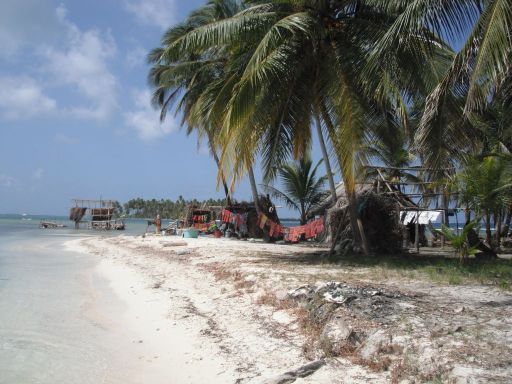
We have traveled almost 14,000 miles on Rachel and have finally made it to paradise. The San Blas , Kuna Yala to the locals - is the one of the most amazing places we have been to date. There are over 300 islands in this archipelago. Some are just a spit of sand with a palm tree or two, while others are almost half a mile long. And then there are the other hundreds that are in between. All are beautiful with swaying palm trees, white sand, warm breezes, and lots of beach treasures, a beach comber's paradise.

A beautiful island

One more beautiful island

Another island - are these getting boring?

OK maybe just one more lovely island

Most of the time we get to sail in clear blue waters behind coral reefs which means great wind for sailing without big ocean waves. With winds between 10 and 15 knots for the most part, it's not hard work, and everything is close enough together that we don't have to be in a hurry , we've been sailing a lot down here. After a few hours underway we pick a spot to anchor, sometimes amid a cluster of other boats, but more often away from the pack on our own. Some nights we are the only boat in the anchorage with our own private little island to explore. Nights have been mostly clear with millions of stars above, a sailor's paradise.

The waters between the islands usually run from 50 to 150 feet deep and are a beautiful dark blue. As we approach the islands the depth can go from 100 feet to 10 feet in an instant, requiring us to be alert and have good light so we can see the reefs and sand bars. We nuzzle up to a beach or sand bar, drop the anchor, and drift back into maybe 60 feet of water. This was a bit disconcerting at first but after a week or so we got used to it. Now Rachel is just a few hundred feet from the beach allowing us to easily swim ashore and walk around the islands. Sometimes we have to anchor a little further out but it's still easy to dinghy in, explore, and cool off with a relaxing dip in the water. Each island and chain of islands is surrounded by coral reefs, and also quite a lot of shipwrecks. This means exploring fish and coral heads to your hearts content, a swimmer's, snorkeler's, and diver's paradise.

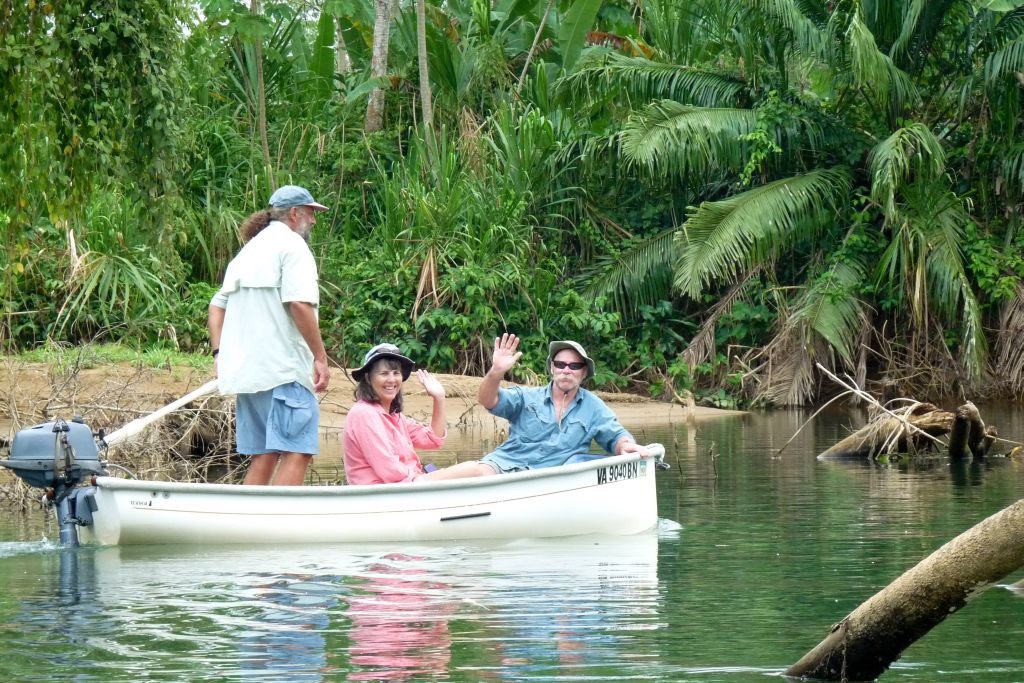
Dinghy trip into the jungle up the Rio Diablo with our visiting friends Shep and Deb

Many of the islands have one or two Kuna families living on them. They seem to rotate families on the islands, all seeming to come from villages on the mainland. We're not sure if this is work related, collecting coconuts, retaining ownership by habitation, or vacation for them. Whatever it is, they seem happy to be out here. At any rate, we're in the third world for sure - the Kuna live in dirt floor huts made from bamboo and palm fronds, and have very few possessions. Hammocks to sleep in, cooking and eating utensils, a few clothes, a machete, and usually a dugout canoe, called an ulu with paddles carved from boards and a sailing rig. Some very well-to-do Kunas have outboard motors for their ulus. So far we have found the Kuna to be honest, gentle, happy, and open, an anthropologist's paradise.

Isla Gerti, a very traditional island

Kuna settlement on Canbombia displaying molas for sale

Another Kuna settlement on Canbombia

Kuna settlement on the island of Tiadup

An old man carving a nuchu, a good luck statue displayed in many kuna huts

The standard mode of transportation in Kuna Yala is the ulu or dugout canoe. Sometimes they are paddled and sometimes they have homemade sails, often patchworked with any fabric they come across.

The men go out fishing every day and will often come around the cruising boats every afternoon selling their catch. Looking out from the boat we see them standing in their ulu wearing only underwear (their version of swimming shorts) with big grins on their faces, holding up a crab or lobster or fish, as if to say 'Look what I caught!'. We usually troll a fishing line when we move around so if we haven't managed to catch a fish we gladly buy from the locals at very reasonable prices - a seafood lover's paradise.

The women tend to stay on shore. They cook fish, bake bread, make molas, and bead. (Note: Google 'Kuna Yala mola' to learn more about molas). Whenever we go ashore on an island that's inhabited we politely ask permission to walk around. Permission is always granted. As the women see us approaching they scurry to get their bucket full of molas and arrange them for us to see. Julie had one of the women make her a beaded anklet, made to measure. It's one long string of beads that they wrap around and around and the beads line up to make a kuna design. Most of the local kuna women wear molas and sport these beads around their arms and legs. The molas and beads also make great gifts, a shopper's paradise.

Julie with Venancio 'Master Mola Maker'

Mola makers will paddle up to the boat and without a lot of encouragement they are on board showing their molas

Julie and our visiting friend Deb shopping for molas

The children sometimes get to go out fishing with the men or go out with women paddling an ulu around the cruising boats to sell molas or bread or they just play on the islands and in the water always laughing and enjoying life. Wherever we go the children appear around us smiling and saying "Hola!" (pronounced OH-la - Spanish for hello), and laughing and grinning when we say "Hola!" back to them. They almost always ask our names and will repeat them several times, we do the same with them. Sometimes we learn Kuna words from them like 'morbep' and teach them that it's 'conch' in English. Being so far from our grandchildren, we always enjoy spending time with the kids, a grandparent's paradise.

Some little boys on Canbombia 'helping' to sell molas

Anyway, it's time for us to get back to doing whatever it is we do. Today's a bit breezy so the wind generator is cranking out the amps. Thanks to the wind generator, the water maker is running, producing gallons of clear, fresh water from the sea without using any fuel. So it looks like we may get some reading done today. After lunch we just may take a nap. Or we might go snorkeling. 'Time and tide wait for no man' - no need for us to wait, we hardly ever know the time or the tide - the tide always seems to be less than a foot, anyway. You can tell we're really enjoying ourselves by this snippet of conversation from earlier this morning:

Julie: "What day is it today?"
Mark: "I dunno, maybe Wednesday or Thursday?"
Julie: "I'll turn on the computer. Oh! It's Thursday March 17th."
Julie, looking at the calendar: "Oh, it's St Patrick's Day"
Mark: "Happy St. Patrick's Day, sweetheart!"

Happy St. Patrick's Day from paradise,

03 March, 2011

Isla Tigre

Position: N 09 35.059 W 078 41.092
Location: Isla Tigre, Kuna Yala, Panama

The local indigenous people call themselves the Kuna. Their name for the San Blas Islands is Kuna Yala. Kuna Yala, while a part of Panama, is ruled independently by the Kuna general congresso. Recognized as an official reserve in 1938, Kuna Yala was granted full administrative and judicial autonomy in 1953.


No Kuna is allowed to marry a non-Kuna. If they do, they are expelled from Kuna Yala. While ensuring cultural integrity, it has also generated some genetic issues including albinos. They are a matrilineal society, the women control the money and the husband moves in with the wife and her family. Often, a woman will choose her husband rather than vice-versa.

Isla Tigre (pronounced EES-la TEE-gray) is an island, in Kuna Yala, a few miles off the Panamanian coast. On February 26, 1925, they, along with 6 other islands, rebelled against the Panamanian government. We are visiting the island to view and participate in their annual rebellion re-enactment and festival.


The first act takes place in the congresso (or town hall) with the Sailas (chiefs) swinging in their hammocks and chanting and the Argar (interpreter) translating the wisdom and putting it into perspective for the people who sit on hard wooden benches. Before the reenactment begins, we are given a brief history in English. In brief it goes like this:


The Kuna were happy living their traditional lives on Isla Tigre. One day a Panamanian school teacher approached them to ask about starting a school on the island. The sailas (chiefs) declined permission and the teacher was asked to leave. Some time later he returned with several Panamanian police. Using force, they imposed their will upon the people. They began a program to stamp out Kuna traditions that form the very heart of the people. Many traditions were outlawed and the participants were beaten and put in jail. They forced Kuna women to dance with them, this angered the men. They forced the children to go to their school.


The police celebrated carnival on February 25th. The rebellion was scheduled for the 25th because the police would be drunk making them easier to attack. During the rebellion two men were killed. One was a Panamanian police officer and one was a Kuna police officer who was viewed as having betrayed his people. After the rebellion the Panamanian government mounted a military campaign, and only intervention by the US Navy prevented bloody retaliation.


As the narration continues, the congresso slowly fills. The sailas lie in their hammocks, singing and greeting the people who arrive in ones and twos. Everyone is happy. Everyone is wearing traditional clothes. Then the school teacher arrives. There is discord in the congresso. The school teacher leaves, then returns with the police who start pushing people around and beating them. That's the end of act one. We are told there will be an intermission before the start of act two.


We go outside to the square. Several men in traditional dress begin to play a tune on bamboo pipes similar to Peruvian pipe music. The musicians and some women, also in traditional dress and playing calabash gourd rattles - begin to dance. The music is haunting, beautiful, and repetitive. Surprisingly the dance reminds us a bit of a New England contra dance - not so much the steps as the patterns the dancers make as they dance. One cruiser tells us some dances follow the same patterns as the traditional molas the women wear. Several minutes later the dancers finish and leave the square, now it's time for act two.


The police are on a rampage. They grab and beat the men who are involved in Kuna traditions ? the medicine man mixing his herbs, the young man accompanying the young woman during her puberty rite, the men who are brewing chicha for the chicha ceremony, the sailas. They have truncheons made of foam rubber and beat their victims mercilessly. Some have bags of red dye they squeeze at an opportune moment, spraying ?blood? everywhere. Women try to hang onto their men, wailing and crying, but the policemen shove them away roughly and continue to beat the men, finally putting them into the jail.


It all seems a bit on the brutal side to us, but, as we look around at the rapt audience we begin to see the sense of it. Young and old alike are enthralled by the action. What better way to keep the revolution alive than to impress upon everyone present what was escaped through rebellion? The sense of shock, sadness, and anger at the oppression is palpable.


Finally act two is over and the musicians and dancers return for another intermission. This time, however, during the traditional music and dancing, young men begin ?sneaking? around the perimeter of the square. Carrying paddles, a foam axe, a pole, they begin stalking one of the policemen. Whenever he stops and turns around, they are not paying attention to him, looking elsewhere, lying down for a nap, chatting, looking innocent. He resumes his patrol and they resume stalking him.

The dancers and pipers finish and exit the square. Suddenly it's Carnival night complete with loud music and dancing! Women, including visiting cruisers are pulled out of the audience onto the dance floor by off-duty policemen. Suddenly, away from the dancing, the policeman in uniform who is on duty is attacked. Beaten to the ground, he is poked, prodded, kicked, hacked, and eventually killed. A second policeman is also attacked and brutally killed. The music and dancing stop to close out the third act. One of the sailas makes several closing remarks we don't understand and the reenactment is finished.


We thank the people for allowing us to attend and for giving us free reign to take photographs, something not normally allowed.

The people of Isla Tigre welcomed us, asked our names (and actually remembered them!), and really seemed to appreciate and enjoy our presence at their festival. They and their reenactment remain a high point in our visit to Kuna Yala.

05 February, 2011

Problems In Paradise

Position: N 09 35.059 W 078 41.092
Location: Naguarchirdup, Lemmon Cays, San Blas, Panama
We've been here for two weeks now, and have really been loving it. It's a tropical paradise. The wind has been mostly North or Northeast in the 10-20 knot range. Since we're behind a barrier reef most of the time, we've been doing a lot of easy, fun sailing in relatively calm water - a sailor's dream come true!
Downwind sailing
Life here is not all fun and games, however - we have problems to deal with, too. Some examples:
After you hook that 28 inch king mackerel you not only have to land it, you also have to fillet it, skin it, and then clean up the mess!! Sheesh!
Same with the giant crabs you buy down here. They need to be cooked and cleaned. Then you still have to actually make the crab cakes and bisques and other yummy treats.
Most nights it rains around 3 am. This means you have to reach up and close the forward hatch, or the bed gets wet. Then, as soon as you close the hatch, it quits raining.
Every couple of weeks you have to do laundry. There is no laundromat so you have to do it by hand. Since you wear so few clothes down here this usually consists of a couple of pairs of shorts, a few tee shirts, and a couple of towels. Then you have to hang it all from the rigging to dry. And don't forget to take it back down before the 3am rain!
There's no curbside trash pickup here in paradise. When the trash builds up, you take it in to a beach on one of the islands and burn it, usually in conjunction with other cruisers, also usually involving beers and swimming. The actual trash burning takes less than an hour, but the "chore" usually requires at least a few hours of your time.
We give aluminum cans to the locals for recycling. But there are no facilities around that can handle glass bottle disposal. Because of this, you're unable to simply enjoy a wonderful sail. Whenever you're in deep water you have to haul up buckets of seawater and fill any empty bottles and non-aluminum cans with it so they will sink to the bottom when you drop them over the side.
There are very few grocery stores in the San Blas, so shopping here can be a real challenge, too. You have to sit on the boat all day reading, waiting for the veggie boat to come by. Then you have to see what they have aboard and make your selections - not always what you want, but there's always something to choose from.

Local dugout canoes called "ulus" come by all the time, too, with molas, limes, bananas, pineapples, fresh fish, lobster, crab, and other delicacies like octopus. Same thing - you have to pick what you want and lift it into the boat. Then you have to pay for it!
Out of over 300 islands there are only two that have Internet access. The one we have been to is a small bar and restaurant with three network cables connected to a painfully slow satellite system for $3 / hour. Going in to use the Internet usually involves having to consume more beers while waiting for an open cable. Once you have a connection, you then have the privilege of waiting most of the first hour for your email to download. The next hour is spent waiting for the online banking pages to load. More beer required. It seems like a pretty good business model. Sorry still no pictures on the blog yet - this connection is w a y t o o s l o w f o r t h a t.
As you can imagine, we've been very busy dealing with all these problems. But no need to feel sorry for us. We've also been working hard to keep our spirits up despite them. We walk around sandy palm tree covered islands almost every day.

We snorkel on reefs full of colorful fish and coral almost every day. We do happy hours on shore or on various friend's boats nearly every night. We read, talk, and nap.
Reunion with friends from the Bahamas - Better Days and Osprey

It's a tough row to hoe, but it's working - we're still happy.
Livin' the good life.....


16 January, 2011

A little island with a big heart

Date: January 10, 2011
Position: N 13 22.717 W 081 22.420
Location: Providencia, Columbia

The island of Providencia is Columbian but it's located many miles away from Columbia in the middle of the SW Caribbean Sea. The island is only 4 miles long and 2 miles wide with a population of just a few thousand all living around the waters edge. The centre of the island is full of high peaks covered in jungle greenery.

The first thing we noticed here, when we went to check in, was that there was no necessity to lock the dinghy, or anything else for that matter. Mr. Bush, the agent we used to clear in, said there is no crime on this island, "Where would they hide if they committed a crime?" He asks. Good point we're about 100 miles from Nicaragua and 45 miles from San Andres, another Columbian island to the South.


The town on Providencia


The second thing we noticed was how friendly everyone was. We were greeted by smiles and "welcome to our island" wherever we went. Even the usually surly teenage boys standing around would break off their conversation and smile and say hello. We got a warm fuzzy feeling about this place from beginning to end.


Twice a week cargo boats arrived from San Andres bringing everything the islanders need. On these days there was much hustle and bustle as food, furniture, appliances, motor bikes, anything imaginable was removed from the ship and placed on the pier. The vehicle of choice here is the motor bike/scooter. Due to the small size of the island there are never great distances to travel, the vehicles have to be shipped in and gas is expensive. We saw families of 4 all riding on one scooter (no helmets or child seats). Therefore, on supply day you will see people carrying all manner of things home on their scooters. Just as a couple of examples: we saw 10 metal re-bar rods about 15 feet long being dragged behind, a mirror or picture probably 5 feet by 7 feet being held by a girl on the back of a scooter with her arms out as wide as she could - good job it wasn't a windy day she'd have been blown off.


View of El Pico from the anchorage
We met a lovely lady here on Providencia. Luceli is a high school science teacher here on the island. She liked to hike and took us on 2 wonderful walks during our visit, one up to El Pico (The Peak) the highest place on the island, about 1,000 ft elevation. The views from there were incredible we could see all the reefs around the island and the different shades of Caribbean waters.


Luceli and her cute niece before we hiked up El Pico

Luceli also invited us to a cultural event the 29th anniversary of the
Providencia Cultural Centre. This centre promotes the musical and cultural heritage of the island. We were treated to dances by adults and children, a local traditional band playing, amongst other instruments, a washtub bass and a jaw bone(the jaw of a horse played with a bone as percussion), and 2 young boys playing french horn and a coronet. During the evening food and drinks were also passed around for us to enjoy. What a lovely evening and we were welcomed by everyone.


The hikers at the top of El Pico

This island is our first stop in the Caribbean where we've encountered the lilting Caribbean accent. Musical and wondrous. The local language is both 'English' and Spanish, seemingly used about same amount. We say 'English' because we can only pick out maybe one word out of a sentence when listening to the locals talking amongst themselves. One of our favourite pastimes was to sit on a park bench listening, trying to retrieve some English words from the conversation. We decided it wasn't so much different words but the emphasis or stress is put in a different place in the words and the sentences are structured differently. Whatever it is, we loved to listen to the lilting cadence of local conversations.


We could be an ad for Presidente beer


One day several of us cruisers rented scooters for the day and toured the island. Being only 11 miles around the perimeter we had plenty of time to meander and stop and chat with people. The highlight of the day was our lunch stop at El Divino Nino (The Divine Child), a restaurant that Luceli had recommended to us, right on the beach at Southwest Bay. The fish mixed platter was their specialty and, although a little pricey for us, $20 for a platter for 2, it was well worth it. A huge platter emerged from the kitchen displaying a whole red snapper, a hog fish, 2 lobster tails, huge butterflied grilled shrimp, crab, conch, plantain cakes, rice and salad. Wow!!!


The 'bikers' outside El Divino Nino

We managed to devour the whole thing leaving only a scattering of bone and shell and needless to say we were not hungry again until the next day. What a feast and absolutely delicious!


Spotted Eagle Ray


Impromptu Regatta.

When asked how often they have a regatta, we were told "some guys start talking trash, pretty soon there's a regatta!!"


We spent almost 3 weeks in Providencia and thoroughly enjoyed our time there. We look forward to visiting this little island with a big heart again.

14 January, 2011

San Blas

Position: N 09 35.059 W 078 41.092
Location: Ogoppiriadup, East Holandes, San Blas, Panama

We leave Providencia in company with our long time sailing buddies on Diva. Diva and Rachel are almost the same length, sail at about the same speed, and both crews have a similar (relatively low) tolerance for foul weather and boisterous seas, making us good traveling companions.

Rachel sails wonderfully. We have about 20 knots on the beam and are making 6, sometimes 7 knots through the water. We are relaxed and happy. Unfortunately, we also have a pretty strong current against us for much of the trip, slowing our progress to only 4 to 5 knots toward our destination. This lengthens our planned 48 hour trip just enough that we arrive off the San Blas after sunset.

Not wanting to enter these reef-strewn waters in the dark, we opt to spend the night "noodling around" about five miles off until the morning when we'll have sufficient daylight to enter safely. The seas build a bit and the wind dies a bit, there are a few showers, a lot of cloud-to-cloud lightening, and lots of big ships heading to or from the Panama Canal, so our night involves a lot of rolling and not much sleep. But our spirits are high as we look forward to the daylight and our first sight of land.

In the morning as we approach Porvenir (where we will "clear in" to Panama), our friends on Osprey (who have already been here for almost a month) hail us on the VHF radio to tell us they're going to meet us. They offer Mark a ride to immigration and the port captain's office, so we don't even have to take our dinghy off the deck!

After clearing in Diva opts to head for the nearby West Lemmons while Osprey and Rachel haul anchor and motor-sail into the wind heading straight for the East Hollandes, about 12 miles East. We drop anchor at 3:15 in the afternoon, tidy up, have a wonderful dinner on Osprey, get to bed early, and sleep hard.

We awake in paradise. Surrounded by small islands complete with sandy beaches and palm trees, crystal clear water, and protected from the ocean swells by the barrier reef, our anchorage is stunningly beautiful. Rachel sits calm and flat while we watch 10' seas crash and spew on the reefs. All the hatches and ports are open allowing the cool air to refresh our living space. We finally made it! Cruising the San Blas Islands has been a goal of ours for several years and we're thrilled to be here.


25 December, 2010

Christmas Wishes

Dear Friends and Relatives,

There are some big differences between Christmas in Providencia and Christmas in the US or UK. For one thing, there's no snow and we're walking around in shorts and t-shirts! We've also not been able to find any Christmas pageants, Christmas plays, Christmas carolers, or Christmas bell choirs - that doesn't mean there aren't any - we just haven't found them yet. Palm trees replace pine trees, loud, thumping music replaces "Silent Night", fireworks replace the lighting of the community Christmas tree, and fresh wahoo stands in for turkey or ham at Christmas dinner. And needless to say, we miss the sounds of our grandchildren opening their presents with shrieks of delight.

There are also some big similarities. The people here are SO friendly. We've been met with nothing but smiles since we've been here. One new friend offered to let the cruisers use her house for a Christmas potluck. Random "Welcome to our island"s pop up in unexpected places. We've been wished "Merry Christmas" or "Happy New Year" everywhere we've gone, and the houses are all decorated.

Our Christmas traditions on Rachel remain the same, however. A lovely, romantic dinner at home on Christmas eve (our 9th wedding anniversary this year), decorations on the mast moose (or, as we call it at this time of year, the "Christmoose tree"), presents at the base of the mast, watching "Miracle on 34th St.", "White Christmas", "It's a Wonderful Life" and other Christmas favorites snuggled together on the settee, visiting and exchanging gifts with our friends on other boats, and many other little things too numerous to mention remind us of home, family, and all of you. You have enriched our lives and for that we are truly grateful.

Wishing you all a happy, peaceful, and fulfilling Christmas.

21 December, 2010

forgot

Sheesh we forgot to tell you that on our first day we had a pod of about 25 dolphins come to play with us for about 30 minutes. They were swimming around the boat, leeping into the air and twirling around, and swimming in the bow wake. As usual we ran up onto the bow sprit, which sticks out in front of the boat about 6ft above the water, and looked down on sometimes 8 dolphins of varying sizes swimming right below us. One time 2 of them flipped over onto their backs and slapped their tails as they were swimming along as they were looking up at us. They wove in and out of each other crossing the bow. It was stupendous and the best dolphin displat we've seen yet.
We took this as a sign that we were going to have a good passage, and it was so.


Wahoo? Woohoo!!


Date: 21 December, 2010
Location: Providencia, Columbia
Position: W13 22.785 N081 22.398


Hello all. We had a good passage and are now anchored in Providencia, a Columbian island in the middle of the western Caribbean, actually nowhere near Columbia.


We set off from Guanaja, Honduras with light winds and motored with the main sail up for almost 100 miles. This was the trickiest part of the trip, getting around Cabo Gracias a Dios (Cape Thanks be to God) named by Christopher Columbus after it took him 30 days to get around it. The prevailing winds and current are on the nose from the East so you have to basically wait until there's a light wind and then make a beeline to get around before the wind picks back up again. Thank goodness for today's modern diesel auxiliary engines - we bet Columbus would have loved to have one <g>.


We were lucky enough to have a light north westerly breeze and were able to motor-sail to make the turn to SE by the Vivorillo Cays. Then the light wind turned north, further assisting us in getting around the Cape, another 100 mile leg.


We had glorious weather and decided to get out a brand new fishing lure as we hadn't had any luck with our old one for over a year. 20 minutes after we put it out Julie came up from down below and said 'What's that?" We looked back and thought something was caught on the line. As we pulled it in we realized what we were seeing was a huge open fishes mouth with our new lure wedged sideways inside it. Sheesh! Wish we'd taken a picture of that!


Immediately we were busy clearing out the cockpit, getting the big gloves, the gaff, and the 'fish vodka'. As we pulled it in close enough to identify, we had to scurry below to get the fish book, we couldn't tell if it was a king mackerel or a wahoo. Mark did his usual great job of gaffing and landing the monster, this time without smearing blood all over the side of the boat, much to Julie's joy. Turns out we had a 45" Wahoo - woohoo! Now for the hard part. We wrestled him into the cockpit where Julie spent some quality time filleting and skinning it. She stripped down to her underwear, not wanting all that extra stinky washing to do, and set about it. An hour and a half later we had 4 huge ziploc bags full of boneless, skinless fillets, a scrubbed and sparkly cockpit, and Julie back in her clothes now that the excitement was over. No more fishing for us this trip since we have no more room in the fridge.

The rest of this 2nd day and night was spent crossing the shallower banks. Some of the 5 other boats we were traveling with also caught fish so we were all happy. We had got too far apart to chat on the VHF radio so we set up an hourly schedule to check in on the SSB and make sure everyone was OK. Towards morning on that 2nd night we started seeing a lot of blips on our radar but no lights. We were starting to get close to the deep ocean water again and decided they must be fishing boats. As daylight came we could see 10 or so boats all within 6-8 miles. This must be a great spot for fishing. These boats probably come from Honduras and Nicaragua, both about 90 miles away, to fish these abundant waters.

After we got into the deep water again we headed SSE for a 3 day run down to Panama. The wind was almost dead behind us and it was a pretty rolly ride. We did our usual morning routine listening to the weather and checked into the Caribbean Nets on the SSB. We called into our weather guru, Chris Parker, to get an update on our weather for the trip down to the San Blas. The first 2 days were going to be great but the last day the wind was shifting to dead behind and there would be numerous squalls, 35 knot gusty winds and a lot of rain. We really wanted to get down to Panama for Christmas but we also really didn't fancy getting all that bad weather on our last day after being at sea for 4 long days. We tossed it around, anguished, pondered and made the decision to head to Providencia.


We'd heard wonderful things about this island and were planning to visit it on our way back north, whenever that may be. Well, if we're going to get stuck somewhere for Christmas this seems a good place. As a bonus, the other five boats we set off with were all planning on stopping here so.....


We had a problem, however. We were going to arrive after dark into an unknown anchorage, no sailor's choice. We chatted with a few people on the SSB net and got waypoints from some friends for getting in. Everyone we spoke with told us it's a nice, wide, easy entry. We were able to get accurate, up-to-date waypoints for getting in, the weather was benign, and the moon was full, so we decided to take the chance and go for it rather than dawdle around overnight and wait to go in during daylight. So that's what we did!! We had plenty of light and dropped the anchor in a spot, for which a friend had sent us the position, at about 10pm. Then we got the first good night's sleep we'd had in three days <yawn>.

This morning we awoke to a drizzle and pretty gusty wind so we were glad we were already in and safe. The harbour is surrounded by mountains and what looks like a quaint little town. We're looking forward to going ashore, checking in, and going exploring. That is, after we get the boat in order and eat a full English breakfast.


Then it's wahoo for lunch and wahoo for dinner for us and all our friends in the anchorage. We wish we could serve up some of Julie's famous "Traditional Olde English Christmas Grilled Wahoo" with all of you too!


Happy Holidays, best wishes, and lots of love from The Rachels,