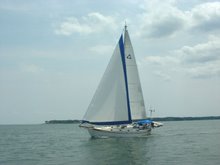
Location: Hotel Catamaran Marina, Rio Dulce, Guatemala
Position: N 15 40.366 W 088 59.538
It's hot here. They don't call it the tropics for nothing. The humidity is almost 100% this morning and it is NOT raining. We keep half gallon jugs of cold water in the fridge, often going through three or four a day. Handkerchiefs are worthless. We have several old hand towels we've designated as “sweat rags” and cycle through them during the day as we work, wringing them out, washing them and and hanging them up to dry when they become too saturated to absorb any more. Our brains often shut down from the heat and humidity. Sometimes they don't start back up until the next morning. Luckily, we have two fans down below that generally run 24/7 and a window air conditioner we usually run for 4-6 hours in the evening to cool Rachel down enough so we can sleep. However, we find some solace in the fact that it's not been as hot here as it's been on the East Coast of the US for the last few weeks.
A day in our lives: We get up, have coffee, breakfast, and check our email. We do a few hours of boat jobs. Some days we go to town to do some shopping. We have lunch. We do a bit more work on the boat or read for a while, then we go up to the pool. The pool is usually warm and only slightly more humid than the air, but it's nice to relax and even though it's warm, the water does eventually cool us down a bit. We hang out at the pool chatting with our friends until either “the afternoon thunderstorm” or dusk begins to fall, whichever comes first. We go back to the boat and, before the bugs come out, seal ourselves into our cocoon for the night. Since we'll be cooking we start the air conditioner. We eat dinner, do the dishes, and watch a borrowed movie, play a game, or read until it's time to go to bed – usually before 9:00 pm.
It's like we've entered a place where time stands still. Or perhaps runs backwards. Today is like yesterday which is like the day before. Days turn into weeks turn into months. One boater we know says “I came here 14 years ago for hurricane season and I'm still here.” Sometimes at the pool we have earnest discussions:
“When was it that we saw that in town?”
“I don't know...it could have been Monday!”
“I thought it was Saturday because it was fresh vegetable day.”
“Yes you could be right but I'm thinking it might have been Sunday.”
“Could it have been two weeks ago?”
“Well I KNOW it wasn't yesterday!!!”
Everyone agrees “Yes it was NOT yesterday.”
Obviously, the Khronicles have suffered. We've dropped the ball, come apart at the seams, blundered, floundered, hemmed and hawed, bobbled, lurched, staggered, stumbled, muddled, goofed, and generally screwed the pooch Khronicle-wise for the last couple of months.
The one big break we had in our daily routine was a road trip with friends from two other boats to see the Mayan ruins at Tikal and Yaxha (pronounced “yih-SHAH”). We've got a Khronicle about it in the works, but haven't managed to find time to work on it, what with our busy day-to-day sleeping, eating, working, sweating, resting, reading, swimming, and socializing schedule. But we're sure we'll get to it. One of these days. Yawn.
What day is it, again?
Mark & Julie
s/v Rachel
pictures will eventually be posted ....
17 July, 2010
20 June, 2010
Mayan Ruins
| Date: June 20. 2010 Location: Tikal National Park, Guatemala Position: N 17 13.330 W 089 37.416 We started this Khronicle back in June and are just now getting back to it. And we actually have some pictures this time, too! Inland travel is one of the best perks when you're “on the Rio”. Guatemala is rich in Mayan culture and ruins and there are several well-developed sites within reach. Back in June we took a trip to the Mayan ruins at Tikal (“tih-cahl”) and Yaxha (“yah-shah”) in the northern part of Guatemala along with our friends on “Osprey” and “Diva”.
|


01 May, 2010
Blame It On “The Rio”
Location: Hotel Catamaran Marina, Rio Dulce, Guatemala
Position: N 15 40.366 W 088 59.538
We last left you at Bahia de Graciosa as we were waiting to cross the shallow bar into Livingston, Guatemala to check in to the country on the morning of Thursday, April 27th.
We got an early start, raising anchor at 5 am to travel the 11 miles to the sea buoy off Livingston. We needed to be there no later than 7 am to catch the highest part of the tide before it started to fall. We made it in time and had no problems going in - we saw nothing less than 6.8 feet, exactly as planned.
After we had crossed the bar we saw a boat with a 7.3ft draft being prepared to leave Livingston. They obviously could not cross the bar as we had done so a smaller vessel had their main halyard and was pulling them over sideways, so their keel would kick over making their draft less. The sailboat was motoring at about a 15 degree heel. Wow, what a sight! They managed to navigate over the bar with no problem.
On the advice of friends, we decided to use an agent named Raul to facilitate clearing in. We anchored off the town of Livingston and waited for 8:00 when Raul's office opened. He arrived at our boat at about 8:30 with 6 officials: customs, immigration, sanitation (a doctor – in scrubs!), a military official, and the port captain all in their appropriate uniforms. That's a lot of people in Rachel's cockpit! If we had not used Raul we would have had to go to each of these people's offices and wait to see each of them, the whole process taking much longer.
We're not really sure why they all needed to come because only the Customs and Immigration people filled out any paperwork and spoke to us. But when in Rome.... So they all sat there for a while and chatted, then they all went back ashore. We were instructed to wait an hour, then go in to the bank to exchange dollars for Quetzals (a US dollar is currently worth about 8 Quetzals) and to go to Raul's office to pay and pick up our visas and boat papers. Wow! That was easy!!
We had heard that Livingston is not a very safe place to anchor out for the night, so we were looking forward to leaving as soon as possible and begin making our way up the river. By 11am we were back on Rachel with our paperwork, after a lovely wander around the town. Soon we were headed up 'the Gorge'. During it's last 7 miles before exiting the coast, the Rio Dulce flows through an absolutely stunning gorge. Some early Johnny Weismueller Tarzan movies were filmed here - you know – the ones where he flings himself off a cliff hanging onto a vine or into the water – we saw his cliff!
The scenery was spectacular and to make the trip even better there were lots of local Guatemalans fishing from wooden dugout canoes, locally called “cayucos”. Some were casting nets, some setting traps with floats . This is obviously a major source of income and / or food in this area. It was like stepping back in time. We slowly meandered up the winding river wanting to make sure we took in all the sights. After a while we started seeing Mayan style “palapa” houses with a 'garage' of dugout canoes at the waters edge.
What a great trip. Kids, maybe 8 years old, wearing their school uniforms, paddling themselves to school in little dugout canoes. The paddles are cut from boards with a long hourglass shape to form the handle and the blade.
We could have spent all day traveling back and forth up and down this stretch of the river but we needed to get safely anchored before dark. At the top of the gorge the river opened out into La Golfete, a beautiful lake about 10 miles long and 4 miles wide. We were almost at our destination of Texan Bay just inside the lake. A small marina has been built here, by Texans no less. It is only accessible by water and is up a picturesque meandering creek. We anchored for the night off the marina and dinghied in to eat and check out the cold Guatemalan beer. We have not been in a freshwater anchorage with rushes and forest for such a long time we really enjoyed the evening and early morning – especially the sounds of birds, frogs and other wildlife not yet identified.
Next morning we made the 15 mile trip through the lake and further up the river to Fronteras, the center of “The Rio” where all the cruisers come to escape hurricane season. We have promised ourselves that we will make a trip back to La Golfete and Texan Bay after we get our boat jobs done. We want to row our wee “Belle” up the little tributaries and see what we find.
At any rate, we are now tied to a dock. We were actually a bit surprised that we remembered how to dock Rachel. We moved into our slip yesterday after being anchored off the marina for three days waiting for other boats to leave, move, and otherwise make room for us. Rachel will be here for the next seven months while we knock several jobs off our “todo” list, do some inland travel, and make a visit back to the US.
Getting our boat jobs done might be a tough row to hoe, however. The resort has a pool, restaurant, bar and lounge with the biggest TVs in the area (not THAT big), lots of little cabins, tennis court, unlimited water and hot showers (aaahhhh!!), and free scheduled launch service into town. Marina guests also get happy hour prices at both bars all day long (cheap and very dangerous!), a 10% discount on meals, and a 20% discount on cabins for guests. All this for $168 / mo. Oh, there's also a book exchange in the main lounge, so it doesn't look like we'll run out of reading material any time soon. It's a tough job, but somebody's got to do it!
Obviously, it's taken us a good bit of time just to catch you all up with our current position. Now all we have to do is is catch you up on what we've been doing since we got here. Time moves slowly here. All we can say is ...
Blame it on the Rio ...
Position: N 15 40.366 W 088 59.538
We last left you at Bahia de Graciosa as we were waiting to cross the shallow bar into Livingston, Guatemala to check in to the country on the morning of Thursday, April 27th.
We got an early start, raising anchor at 5 am to travel the 11 miles to the sea buoy off Livingston. We needed to be there no later than 7 am to catch the highest part of the tide before it started to fall. We made it in time and had no problems going in - we saw nothing less than 6.8 feet, exactly as planned.
After we had crossed the bar we saw a boat with a 7.3ft draft being prepared to leave Livingston. They obviously could not cross the bar as we had done so a smaller vessel had their main halyard and was pulling them over sideways, so their keel would kick over making their draft less. The sailboat was motoring at about a 15 degree heel. Wow, what a sight! They managed to navigate over the bar with no problem.
 |
On the advice of friends, we decided to use an agent named Raul to facilitate clearing in. We anchored off the town of Livingston and waited for 8:00 when Raul's office opened. He arrived at our boat at about 8:30 with 6 officials: customs, immigration, sanitation (a doctor – in scrubs!), a military official, and the port captain all in their appropriate uniforms. That's a lot of people in Rachel's cockpit! If we had not used Raul we would have had to go to each of these people's offices and wait to see each of them, the whole process taking much longer.
 Livingston |
We're not really sure why they all needed to come because only the Customs and Immigration people filled out any paperwork and spoke to us. But when in Rome.... So they all sat there for a while and chatted, then they all went back ashore. We were instructed to wait an hour, then go in to the bank to exchange dollars for Quetzals (a US dollar is currently worth about 8 Quetzals) and to go to Raul's office to pay and pick up our visas and boat papers. Wow! That was easy!!
We had heard that Livingston is not a very safe place to anchor out for the night, so we were looking forward to leaving as soon as possible and begin making our way up the river. By 11am we were back on Rachel with our paperwork, after a lovely wander around the town. Soon we were headed up 'the Gorge'. During it's last 7 miles before exiting the coast, the Rio Dulce flows through an absolutely stunning gorge. Some early Johnny Weismueller Tarzan movies were filmed here - you know – the ones where he flings himself off a cliff hanging onto a vine or into the water – we saw his cliff!
 Travelling up the gorge |
 |
The scenery was spectacular and to make the trip even better there were lots of local Guatemalans fishing from wooden dugout canoes, locally called “cayucos”. Some were casting nets, some setting traps with floats . This is obviously a major source of income and / or food in this area. It was like stepping back in time. We slowly meandered up the winding river wanting to make sure we took in all the sights. After a while we started seeing Mayan style “palapa” houses with a 'garage' of dugout canoes at the waters edge.
 |
What a great trip. Kids, maybe 8 years old, wearing their school uniforms, paddling themselves to school in little dugout canoes. The paddles are cut from boards with a long hourglass shape to form the handle and the blade.
We could have spent all day traveling back and forth up and down this stretch of the river but we needed to get safely anchored before dark. At the top of the gorge the river opened out into La Golfete, a beautiful lake about 10 miles long and 4 miles wide. We were almost at our destination of Texan Bay just inside the lake. A small marina has been built here, by Texans no less. It is only accessible by water and is up a picturesque meandering creek. We anchored for the night off the marina and dinghied in to eat and check out the cold Guatemalan beer. We have not been in a freshwater anchorage with rushes and forest for such a long time we really enjoyed the evening and early morning – especially the sounds of birds, frogs and other wildlife not yet identified.
 Rachel at anchor in Texan Bay, we really need those shade awnings down here. |
Next morning we made the 15 mile trip through the lake and further up the river to Fronteras, the center of “The Rio” where all the cruisers come to escape hurricane season. We have promised ourselves that we will make a trip back to La Golfete and Texan Bay after we get our boat jobs done. We want to row our wee “Belle” up the little tributaries and see what we find.
At any rate, we are now tied to a dock. We were actually a bit surprised that we remembered how to dock Rachel. We moved into our slip yesterday after being anchored off the marina for three days waiting for other boats to leave, move, and otherwise make room for us. Rachel will be here for the next seven months while we knock several jobs off our “todo” list, do some inland travel, and make a visit back to the US.
Getting our boat jobs done might be a tough row to hoe, however. The resort has a pool, restaurant, bar and lounge with the biggest TVs in the area (not THAT big), lots of little cabins, tennis court, unlimited water and hot showers (aaahhhh!!), and free scheduled launch service into town. Marina guests also get happy hour prices at both bars all day long (cheap and very dangerous!), a 10% discount on meals, and a 20% discount on cabins for guests. All this for $168 / mo. Oh, there's also a book exchange in the main lounge, so it doesn't look like we'll run out of reading material any time soon. It's a tough job, but somebody's got to do it!
Obviously, it's taken us a good bit of time just to catch you all up with our current position. Now all we have to do is is catch you up on what we've been doing since we got here. Time moves slowly here. All we can say is ...
Blame it on the Rio ...
26 April, 2010
Contrasts
Location: Bahia La Graciosa, Guatemala
Position: N15 51.400 W 088 33.406
We leave the island of Utila and begin to head further west. Our ultimate near-term goal is to is to arrive at Livingston, Guatemala by April 27th.
This date is significant to us because the high tide there at 7:00 am is 1.84' higher than mean low water. Rachel draws 6' and the entrance to the Rio Dulce is blocked by a wide sand bar that's 5' deep at mean low water. By waiting until the 27th, we should see 0.84' under our keel as we approach Livingston to clear in to Guatemala.
The fact that the high tide occurs during the morning is an added plus for us. Livingston has a terrible reputation for theft and boardings – everyone's advice is to clear in and get the heck out, heading up river to spend the night at one of the “safe” anchorages further up stream. Needless to say, this got our attention and we decide that the 27th fits our plans to a “T”.
We've planned our trip west in a series of day trips so we won't be doing any overnight sails. Not for any particular reason other than we feel like it. We need to clear out of Honduras on April 22nd because our 90 day visas expire on the 23rd. This will leave us in limbo for several days between clearing out of Honduras and clearing in to Guatemala after we cross the bar at Livingston, but everyone we've talked to about it tells us a week or more is fine – no one will mind – so we decide to not let it bother us, either.
Our first scheduled stop along the coast of Honduras is Puerto Escondido. We sail across the Bay of Honduras to Punta Sal and head south along the mountainous and rocky shore. As we approach, the anchorage opens to us and we see a beautiful beach surrounded by mountains and jungle. There are no other boats here, so we pick our spot, drop the anchor, and relax (position N 15 54.544 W 087 37.908 W). This little harbor lies within the bounds of the “Parque Nacional Jeanette Kawas”, a 782 sq. km. National park - and it's a total gem.
We see a couple of locals walking the beach with a dog. The dog runs into the woods and we hear what sounds a bit like a bunch of other dogs barking at it. We finally realize that the “barking” we're hearing is the resident howler monkeys hollering at the dog! We eat dinner in the cockpit listening to the varied sounds of the jungle and the howler monkeys. It's amazing and a little spooky. And we love it.
In the morning we enjoy another show from the howlers. They seem to be more vocal in the morning and at sunset. The whole troop participates in this morning's serenade.
Today is our 3rd year anniversary living aboard Rachel and cruising. We couldn't ask for a more perfect location for this milestone occasion.
The cruising guide says that there are trails in the park so we get ready to head in to shore for a hike. Julie looks over and sees a group of people on the beach. “Hurry” she says to Mark “we can ask that group about the trails”.
On our arrival at the beach we discover it's a group of Americans! They are in Honduras with a church group from Mystic, CT. The church built a school a few miles inland 20 years ago and each year a group comes down to add a new building or do upgrades and repairs. Today is their last day and they traveled here with a couple of guides for a day off before returning to the US.
We ask if we can tag along as the guides speak English and they say sure. We walk through the jungle trail and the guides point out the howler monkeys way up in the trees, gorgeous flowers in bloom, and a few different types of edible wild fruit. We walk with the group over to the next bay where they all get back in their boats and leave us to wander the trails and the miles of empty beaches alone again in this magical place. There are supposed to be jaguars here too but we are hoping we don't bump into one.
It's hard to tear ourselves away, but on Saturday morning we haul anchor and head for our next stop – Omoa. The anchorage at Omoa is protected from the south and east, but is exposed from every other direction. The wind is supposed to be light and from the SE, so we feel pretty good about being here.
That is until the “music” starts. Bump ba dump. Bump ba dump. Bump ba dump. Poor Rachel is shivering her timbers. We're being thrown about the cabin. Bump ba dump. Bump ba dump. Our brains turn to jelly. How can anyone possibly enjoy this? If Rachel were a wooden boat, the caulking would be vibrating out of its seams. Bump ba dump. We turn on the fans hoping for some acoustic masking. We turn on our own music hoping to drown it out. But the insistent bass continues to rumble through all our attempts to mitigate it. We scream and howl, we weep like children and beg for mercy, we cover our heads with our pillows. We drink. Exhausted, and a bit tipsy, we finally pass out and dream strange, rhythmic dreams.
The thumping finally stops at about 4:00 am. Hallelujah! Quality sleep! Until 7:30 – Bump ba dump. Bump ba dump. For crying out loud! It's Sunday morning and they've started it again! Aiiieee!! We'd hoped to spend the day here and check out the town and the nearby castle, but this is too much. We haul anchor and get the heck out of there a day ahead of schedule.
We arrive at Cabo Tres Puntas, Guatemala in late afternoon (position N 15 55.686 W 088 36.028). The anchorage is nice and calm, protected as it is from the 15 knot easterly trades we're seeing. We have a day to kill, so we plan to spend tomorrow relaxing and getting ourselves and Rachel ready to cross the bar to Livingston. It's calm, there's a light breeze and we sleep soundly, hearing only the sounds we're used to – each other breathing and Rachel's little creaks and gurgles.
We wake up in the morning and notice that we're bouncing a bit more than we think we should be. The wind, predicted to be light from the SE to E for the next several days has shifted to the West and is building. By 7:30 am it's blowing 20-25 knots and we're taking water over the bow!
We decide to haul anchor and head for Bahia De La Graciosa, a 5 mile trip south. Julie goes up on the bow to operate the windlass while Mark mans the helm, keeping Rachel's bow into the waves. Suddenly the chain piles up in the chain locker and the windlass jams. So here we are, bouncing around on a short rode, yanking at the anchor (which holds wonderfully), and wondering how long the windlass can take this abuse before it breaks loose. We trade places and after about 10 minutes of effort (and generous application of the “appropriate language toolbox”) Mark manages to free the chain and we finally get the anchor up and are under way.
The best part about our new destination is that getting there puts the wind and waves slightly aft of beam (that means coming at us from the side and slightly behind us) making the ride a lot more comfortable than is was when we were banging right into them. We feel our way through the entrance, tuck up behind Punta Manglar, and drop the anchor.
The difference is amazing. We still have the same wind we had at Cabo Tres Puntas, but there are no waves. It's like being in a lake! The breeze cools the boat above and below. And there are no bugs! We really like this place and wonder why more cruisers don't stop here.
What contrasts we've experienced over the past several days! Going from Puerto Escondido and it's howler monkeys to Omoa and it's howling basses. From being bounced around like a cork at Cabo Tres Puntas to this peaceful, quiet anchorage. We decide to spend the remainder of the day relaxing, reading, and generally winding down from all the excitement, looking forward to a new experience tomorrow when we enter the Rio Dulce.
PS - Real time update – 27 May, 2010
In case any of you heard about the volcano erupting in Guatemala City, don't worry it's 150 miles from us. Poor Rachel does have some black volcanic ash on her decks. And her canvas. And her awnings. And her dinghy. So we are obviously not quite far enough away. http://news.bbc.co.uk/2/hi/world/latin_america/10186112.stm.
Oh, and that potential tropical storm in the eastern Pacific? The one that may track right over us? Not to worry. http://www.wunderground.com/blog/Weather456/show.html
Then there's the weevil infestation that Julie just found in our beans and flour.
And the ants sneaking in via our docklines – ants, schmantz.
We're doing just fine. Thank goodness Weather Underground downgraded Monday's predicted heat index of 150 degrees F to a mere 120 degrees F or we might have had a problem!
Position: N15 51.400 W 088 33.406
We leave the island of Utila and begin to head further west. Our ultimate near-term goal is to is to arrive at Livingston, Guatemala by April 27th.
This date is significant to us because the high tide there at 7:00 am is 1.84' higher than mean low water. Rachel draws 6' and the entrance to the Rio Dulce is blocked by a wide sand bar that's 5' deep at mean low water. By waiting until the 27th, we should see 0.84' under our keel as we approach Livingston to clear in to Guatemala.
The fact that the high tide occurs during the morning is an added plus for us. Livingston has a terrible reputation for theft and boardings – everyone's advice is to clear in and get the heck out, heading up river to spend the night at one of the “safe” anchorages further up stream. Needless to say, this got our attention and we decide that the 27th fits our plans to a “T”.
 Rachel in Puerto Escondido |
Our first scheduled stop along the coast of Honduras is Puerto Escondido. We sail across the Bay of Honduras to Punta Sal and head south along the mountainous and rocky shore. As we approach, the anchorage opens to us and we see a beautiful beach surrounded by mountains and jungle. There are no other boats here, so we pick our spot, drop the anchor, and relax (position N 15 54.544 W 087 37.908 W). This little harbor lies within the bounds of the “Parque Nacional Jeanette Kawas”, a 782 sq. km. National park - and it's a total gem.
We see a couple of locals walking the beach with a dog. The dog runs into the woods and we hear what sounds a bit like a bunch of other dogs barking at it. We finally realize that the “barking” we're hearing is the resident howler monkeys hollering at the dog! We eat dinner in the cockpit listening to the varied sounds of the jungle and the howler monkeys. It's amazing and a little spooky. And we love it.
 |
Today is our 3rd year anniversary living aboard Rachel and cruising. We couldn't ask for a more perfect location for this milestone occasion.
 |
The cruising guide says that there are trails in the park so we get ready to head in to shore for a hike. Julie looks over and sees a group of people on the beach. “Hurry” she says to Mark “we can ask that group about the trails”.
On our arrival at the beach we discover it's a group of Americans! They are in Honduras with a church group from Mystic, CT. The church built a school a few miles inland 20 years ago and each year a group comes down to add a new building or do upgrades and repairs. Today is their last day and they traveled here with a couple of guides for a day off before returning to the US.
 |
 |
It's hard to tear ourselves away, but on Saturday morning we haul anchor and head for our next stop – Omoa. The anchorage at Omoa is protected from the south and east, but is exposed from every other direction. The wind is supposed to be light and from the SE, so we feel pretty good about being here.
That is until the “music” starts. Bump ba dump. Bump ba dump. Bump ba dump. Poor Rachel is shivering her timbers. We're being thrown about the cabin. Bump ba dump. Bump ba dump. Our brains turn to jelly. How can anyone possibly enjoy this? If Rachel were a wooden boat, the caulking would be vibrating out of its seams. Bump ba dump. We turn on the fans hoping for some acoustic masking. We turn on our own music hoping to drown it out. But the insistent bass continues to rumble through all our attempts to mitigate it. We scream and howl, we weep like children and beg for mercy, we cover our heads with our pillows. We drink. Exhausted, and a bit tipsy, we finally pass out and dream strange, rhythmic dreams.
The thumping finally stops at about 4:00 am. Hallelujah! Quality sleep! Until 7:30 – Bump ba dump. Bump ba dump. For crying out loud! It's Sunday morning and they've started it again! Aiiieee!! We'd hoped to spend the day here and check out the town and the nearby castle, but this is too much. We haul anchor and get the heck out of there a day ahead of schedule.
We arrive at Cabo Tres Puntas, Guatemala in late afternoon (position N 15 55.686 W 088 36.028). The anchorage is nice and calm, protected as it is from the 15 knot easterly trades we're seeing. We have a day to kill, so we plan to spend tomorrow relaxing and getting ourselves and Rachel ready to cross the bar to Livingston. It's calm, there's a light breeze and we sleep soundly, hearing only the sounds we're used to – each other breathing and Rachel's little creaks and gurgles.
We wake up in the morning and notice that we're bouncing a bit more than we think we should be. The wind, predicted to be light from the SE to E for the next several days has shifted to the West and is building. By 7:30 am it's blowing 20-25 knots and we're taking water over the bow!
We decide to haul anchor and head for Bahia De La Graciosa, a 5 mile trip south. Julie goes up on the bow to operate the windlass while Mark mans the helm, keeping Rachel's bow into the waves. Suddenly the chain piles up in the chain locker and the windlass jams. So here we are, bouncing around on a short rode, yanking at the anchor (which holds wonderfully), and wondering how long the windlass can take this abuse before it breaks loose. We trade places and after about 10 minutes of effort (and generous application of the “appropriate language toolbox”) Mark manages to free the chain and we finally get the anchor up and are under way.
The best part about our new destination is that getting there puts the wind and waves slightly aft of beam (that means coming at us from the side and slightly behind us) making the ride a lot more comfortable than is was when we were banging right into them. We feel our way through the entrance, tuck up behind Punta Manglar, and drop the anchor.
The difference is amazing. We still have the same wind we had at Cabo Tres Puntas, but there are no waves. It's like being in a lake! The breeze cools the boat above and below. And there are no bugs! We really like this place and wonder why more cruisers don't stop here.
What contrasts we've experienced over the past several days! Going from Puerto Escondido and it's howler monkeys to Omoa and it's howling basses. From being bounced around like a cork at Cabo Tres Puntas to this peaceful, quiet anchorage. We decide to spend the remainder of the day relaxing, reading, and generally winding down from all the excitement, looking forward to a new experience tomorrow when we enter the Rio Dulce.
PS - Real time update – 27 May, 2010
In case any of you heard about the volcano erupting in Guatemala City, don't worry it's 150 miles from us. Poor Rachel does have some black volcanic ash on her decks. And her canvas. And her awnings. And her dinghy. So we are obviously not quite far enough away. http://news.bbc.co.uk/2/hi/world/latin_america/10186112.stm.
Oh, and that potential tropical storm in the eastern Pacific? The one that may track right over us? Not to worry. http://www.wunderground.com/blog/Weather456/show.html
Then there's the weevil infestation that Julie just found in our beans and flour.
And the ants sneaking in via our docklines – ants, schmantz.
We're doing just fine. Thank goodness Weather Underground downgraded Monday's predicted heat index of 150 degrees F to a mere 120 degrees F or we might have had a problem!
15 April, 2010
Overcoming Obstacles
Location: Jonesville, Roatan, Honduras
Position: N16 23.240 W086 22.568
All over the world people overcome obstacles, annoyances and inconveniences in their lives on a daily basis.
Here in the Bay Islands each island is largely surrounded by barrier reef. These calm the ocean waves before they hit land and therefore provide a safer place to build communities. The islands are covered in high hills covered with rain forest so transportation from one community to the next, before roads were built, was by water. The problem was that to travel from one bay to the next you had to go outside the reef into the ocean and sometimes big seas.
Solution!! Cut through the coral and mangroves inside the reefs to make canals from one community to the next.
Result – delightful passages through mangrove swamps which create a canopy overhead to provide some shade. On the south side of Roatan you can travel between several bays and about 10 miles without even going out into the ocean. On Guanaja you can travel through the middle of the island from the town of Bonacca to the less populated western side.
Then there are the dories.
In Honduras, a dory is a double ended boat usually ranging from about 15-25' in length with a very narrow beam. Based on dug out canoes, the newer ones are made from wooden planks or fiberglass.
They have an external rudder which is steered using two pieces of line. The driver sits in the aft end of the boat and pulls one string or the other, depending on which way he wants to turn. Most are powered by a single cylinder gasoline engine, though some have modern high-power diesel engines. The gasoline ones don't seem to have a transmission. If the engine is on, the propeller is turning. Imagine starting your car and it immediately takes off in gear. You have no brakes, so you have to anticipate way ahead of time and turn off the engine to coast to a stop at exactly the right place. This of course takes lots of practice. It is also necessary to not pull in front of one of them when they are clipping along because they cannot stop - they will just run into you! The good part is that, since the un-muffled engines in most of the older dories make a putt putt putt sound, so you can always hear them coming.
All of the communities here are on the water and most people do not have land based transportation . Most of them either have some kind of boat, or they ride on water taxis. In the morning you'll see a dory full of kids in their school uniforms being dropped off at school. You'll see older ladies with their umbrellas, for shade, going to church or the store. All the stores have dinghy docks and some communities don't even have roads - they are completely water access only. We have really enjoyed exploring the canals and wandering though the communities by both dinghy and foot. Everyone is so friendly and will wave and shout hello.
PS – it's really May 18th and we wanted to let you all know we're safe and sound in Guatemala, tied to a dock on the Rio Dulce for the next several months. We'll get caught back up with the Khronicles over the next few weeks.
Position: N16 23.240 W086 22.568
All over the world people overcome obstacles, annoyances and inconveniences in their lives on a daily basis.
Here in the Bay Islands each island is largely surrounded by barrier reef. These calm the ocean waves before they hit land and therefore provide a safer place to build communities. The islands are covered in high hills covered with rain forest so transportation from one community to the next, before roads were built, was by water. The problem was that to travel from one bay to the next you had to go outside the reef into the ocean and sometimes big seas.
 Calabash Bight Canal |
 The canal at Jonesville |
 Oak Ridge Canal. These names are not sounding very Central American are they? Remember the British owned this part of the world for a while. |
Solution!! Cut through the coral and mangroves inside the reefs to make canals from one community to the next.
Result – delightful passages through mangrove swamps which create a canopy overhead to provide some shade. On the south side of Roatan you can travel between several bays and about 10 miles without even going out into the ocean. On Guanaja you can travel through the middle of the island from the town of Bonacca to the less populated western side.
Then there are the dories.
 |
In Honduras, a dory is a double ended boat usually ranging from about 15-25' in length with a very narrow beam. Based on dug out canoes, the newer ones are made from wooden planks or fiberglass.
 old dugout canoes ("cayucos") still in use in the Bay Islands |
They have an external rudder which is steered using two pieces of line. The driver sits in the aft end of the boat and pulls one string or the other, depending on which way he wants to turn. Most are powered by a single cylinder gasoline engine, though some have modern high-power diesel engines. The gasoline ones don't seem to have a transmission. If the engine is on, the propeller is turning. Imagine starting your car and it immediately takes off in gear. You have no brakes, so you have to anticipate way ahead of time and turn off the engine to coast to a stop at exactly the right place. This of course takes lots of practice. It is also necessary to not pull in front of one of them when they are clipping along because they cannot stop - they will just run into you! The good part is that, since the un-muffled engines in most of the older dories make a putt putt putt sound, so you can always hear them coming.
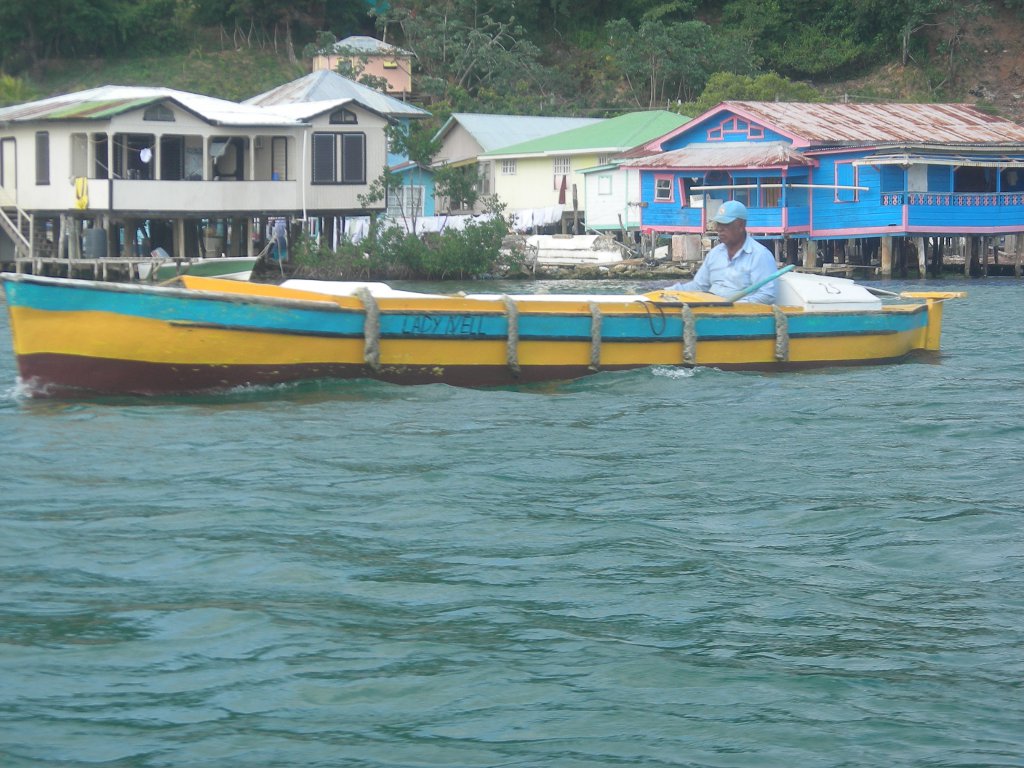 The Lady Nell |
All of the communities here are on the water and most people do not have land based transportation . Most of them either have some kind of boat, or they ride on water taxis. In the morning you'll see a dory full of kids in their school uniforms being dropped off at school. You'll see older ladies with their umbrellas, for shade, going to church or the store. All the stores have dinghy docks and some communities don't even have roads - they are completely water access only. We have really enjoyed exploring the canals and wandering though the communities by both dinghy and foot. Everyone is so friendly and will wave and shout hello.
 Mark relaxing in Bonocca on an old cayuco converted to a swing |
PS – it's really May 18th and we wanted to let you all know we're safe and sound in Guatemala, tied to a dock on the Rio Dulce for the next several months. We'll get caught back up with the Khronicles over the next few weeks.
Subscribe to:
Posts (Atom)