15 April, 2010

Overcoming Obstacles

Location: Jonesville, Roatan, Honduras
Position: N16 23.240 W086 22.568

All over the world people overcome obstacles, annoyances and inconveniences in their lives on a daily basis.

Here in the Bay Islands each island is largely surrounded by barrier reef. These calm the ocean waves before they hit land and therefore provide a safer place to build communities. The islands are covered in high hills covered with rain forest so transportation from one community to the next, before roads were built, was by water. The problem was that to travel from one bay to the next you had to go outside the reef into the ocean and sometimes big seas.

Calabash CanalCalabash Bight Canal


The canal at Jonesville


Oak Ridge Canal. These names are not sounding very Central American are they? Remember the British owned this part of the world for a while.

Solution!! Cut through the coral and mangroves inside the reefs to make canals from one community to the next.

Result – delightful passages through mangrove swamps which create a canopy overhead to provide some shade. On the south side of Roatan you can travel between several bays and about 10 miles without even going out into the ocean. On Guanaja you can travel through the middle of the island from the town of Bonacca to the less populated western side.

Then there are the dories.


In Honduras, a dory is a double ended boat usually ranging from about 15-25' in length with a very narrow beam. Based on dug out canoes, the newer ones are made from wooden planks or fiberglass.

old dugout canoes ("cayucos") still in use in the Bay Islands

They have an external rudder which is steered using two pieces of line. The driver sits in the aft end of the boat and pulls one string or the other, depending on which way he wants to turn. Most are powered by a single cylinder gasoline engine, though some have modern high-power diesel engines. The gasoline ones don't seem to have a transmission. If the engine is on, the propeller is turning. Imagine starting your car and it immediately takes off in gear. You have no brakes, so you have to anticipate way ahead of time and turn off the engine to coast to a stop at exactly the right place. This of course takes lots of practice. It is also necessary to not pull in front of one of them when they are clipping along because they cannot stop - they will just run into you! The good part is that, since the un-muffled engines in most of the older dories make a putt putt putt sound, so you can always hear them coming.
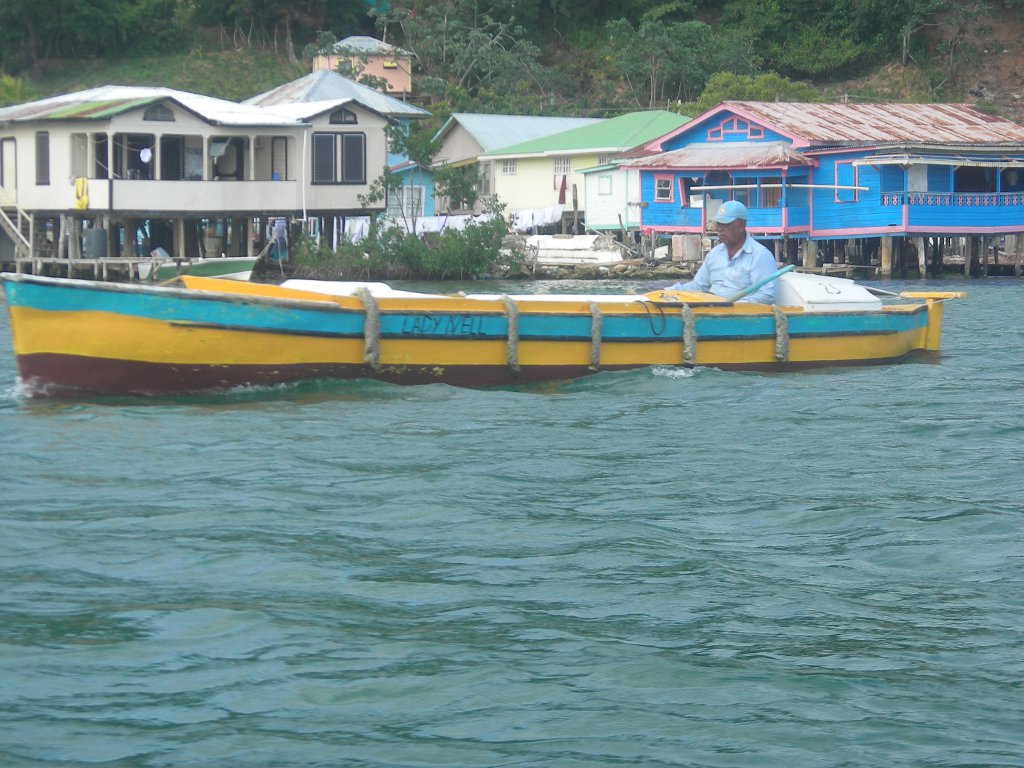
The Lady Nell

All of the communities here are on the water and most people do not have land based transportation . Most of them either have some kind of boat, or they ride on water taxis. In the morning you'll see a dory full of kids in their school uniforms being dropped off at school. You'll see older ladies with their umbrellas, for shade, going to church or the store. All the stores have dinghy docks and some communities don't even have roads - they are completely water access only. We have really enjoyed exploring the canals and wandering though the communities by both dinghy and foot. Everyone is so friendly and will wave and shout hello.

Mark relaxing in Bonocca on an old cayuco converted to a swing

PS – it's really May 18th and we wanted to let you all know we're safe and sound in Guatemala, tied to a dock on the Rio Dulce for the next several months. We'll get caught back up with the Khronicles over the next few weeks.

31 March, 2010

Vacation Take 2


Location: West End, Roatan, Honduras
Position: 16 17.570 N 086 35.841 W

Wow!!  Two vacations in one month - this is awesome! Our son, Dan, from Redding, California was just here for a visit and we got to play again for a whole week. We could get used to this! We snorkeled, ate out, rented scooters, toured the island, visited a lovely botanical garden, sailed, fished, and every sunset we looked for the elusive green flash to no avail.


Even though we didn't have any luck in the fishing department we all had a great time together. Dan got a taste of our cruising lifestyle and enjoyed meeting and hanging out with some of our cruising friends. As an added bonus, he brought a waterproof camera (we have to get one of those) and likes taking pictures - so for a change we actually have some photos to post! As you know pictures tell a thousand words so check these out and see how much fun we had.


Lunch on the beach with friends


Mark & Dan on the rental scooters overlooking the reefs


Barracuda


Dan chillin' on the beach


underwater photos thanks to Dan


Carambola Botanical Gardens


Dan playing with the Monkeys at Gumbalimba Park


Queen Angelfish


Julie & Dan snorkeling


Another sunset with no green flash

Julie & Dan swinging in Gumbalimba park


Thanks for coming Dan - we had a blast!

12 March, 2010

On Vacation


Location: West End, Roatan, Honduras
Position: 16 17.570 N 086 35.841 W

Our friends, Shep & Deb, from Blacksburg were coming for a one day stop on a cruise ship so we thought West End would be a good place to entertain them.
Here's a view of the beach and a resort from Rachel at anchor.

West End (surprisingly located at the west end of Roatan) is a small town that has one street which is just a dirt road. On one side is the Caribbean Sea and the other are a variety of bars, restaurants, little shops, street venders and dive operations.

Mark doing 'research' .

We got here a few days ahead of time so that we could check the place out. As we would only have a day together we wanted to make sure we showed them all the “best” stuff to make sure they’d have a really good time. Also, since Julie’s son Dan will be coming for a visit later this month, we had another valid reason for all our exhausting ‘research’. A tough job but someone has to do it!!

The main street in West End

See how close to the reef we are anchored


We sampled several bars, snorkeled inside and outside the reef to find the prettiest coral and fish, walked on the beach and up the hills. We had stocked up on rum, ice and lunch treats and were ready and excited about their visit.


On the morning of the scheduled visit we received a hail on our VHF radio – “We’re backing in to the cruise ship dock! We’ll be there soon.”

So we went ashore to wait for them. Nothing. So we walked through town, keeping a close eye on all the cabs and vans that went by. Back to the dinghy and still nothing. So we walked through town and back again. Still nothing. Just as we were getting ready to walk through town yet a third time, we received a hail on our handheld VHF from some friends on another boat in the anchorage. Shep and Deb had been trying to hail us, but our handheld wasn’t strong enough to reach the cruise ship. Apparently the winds were too strong and the captain too inexperienced to make the final docking, so they were cancelling the day stop in Roatan and heading to Belize! How disappointing!!

See the cruise ship sailing away with our friends. Note the mountains on the mainland, 26 miles away, in the background

Now we had a big decision to make - what were we going to do with all this food and ice and rum? Easy, invite other cruisers over and have party! We all drank a toast to the missing Shep & Deb.


We stayed a few more days, just to complete our “research” and are now ready for Dan’s visit. Hopefully he won’t get turned away too.
The last week has been like being on vacation. No boat jobs, no shopping, just fun and games and time with (and without :<) friends.

Chillin’

03 March, 2010

Warren

Location: French Cay Harbour, Roatan, Honduras
Position: 16 21.255 N 086 26.646 W

We are anchored inside the bounds of a Honduran marine park – no fishing is allowed within the park boundaries. Knowing this, a local fellow comes around the anchorage in his skiff a couple of times a week selling freshly caught fish out of a cooler. Warren is very personable and witty and we look forward to his visits.

The first day he showed up it was pretty rolly (blowing about 25 knots in the anchorage) and he was bouncing around pretty good in his skiff. He had fresh grouper that day. We haggled over the price - that’s a fact of life here - you never pay the asking price. We picked one out and he said he’d fillet it at no extra charge. He had no knife or cutting board so we handed ours over to him and he deftly filleted the grouper while bouncing all over the place. He had fun calling Mark “Castro” and giving us a hard time about how dull the knife was. Needless to say, Mark had it all sharpened up for Warren’s next visit.

Recently, he’s started calling us “Mr. Mark” and “Mama”. When he came by yesterday he told us he had decided to start growing a beard “like Mr. Mark’s”. Sure enough, there was new stubble on his chin. He also said that, if he likes someone, after they’ve bought from him three or four times he gives them a better deal. Then he threw in two extra conchs with our purchase. So we’re pretty sure he likes us, too.

We don’t buy from him every time he comes by, but we always look forward to his visits as he is invariably cheerful and has time for a chat. His selection is always different and varies from lobster to shrimp to wahoo to grouper to snapper to conch. We never know what he’s going to bring other than his sunny disposition and wit.

01 March, 2010

16 degrees

Location: French Cay Harbour, Roatan, Honduras
Position: 16 21.255 N 086 26.646 W


That’s our current latitude - 16 degrees 21 minutes north of the equator.


Our latitude last summer at Mt. Desert Island, Maine was 44 degrees 21 minutes north. Each minute of latitude equals one nautical mile, so that’s 1,380 nautical miles (or 1,588 statute miles) further south than we were just 6 months ago. If we travel seven degrees further south (420 more nautical miles) we’ll be south of the insurance companies “hurricane box”.


To date, we’ve traveled 12,270 nautical miles (or 14,120 statute miles) on Rachel since we’ve owned her - that’s a distance equal to more than half way around the world! Who’d have thought?


A friend recently emailed us. She and her family have been living aboard and cruising for almost 2 years. She freely admits that she’s always been afraid of sinking or smashing into stuff. The anticipation of thunderstorms, night watches, fog, and dragging anchor all have filled her with trepidation and given her many sleepless nights. She said they’ve suffered through several thunderstorms at anchor this year. Last year she used to stay up all night in the cockpit making sure the boat didn’t move. This year she goes up top, looks around, and when she sees everything’s okay, goes back down and sleeps. Julie wrote back to her and congratulated her on making the transition from “someone who is out cruising” to “someone who has become a cruiser”.


Looking back, we wonder when that happened for us. We remember with great clarity our first overnight sail on Rachel. How excited and nervous we both were, how beautiful the moon was that night. We think about how nervous we were the first time we talked on the ham radio and how naturally it comes to us now.  And how embarrassing the first time we flew Rachel’s spinnaker ended up being.  Then there was the time  Rachel’s engine quit running right in front of the Spa Creek Bridge in Annapolis.  And spending the night at anchor for our first gale. And the first fish we ever caught on Rachel. And, not so long ago, the first time we both got sea sick.


There have been so many “firsts” for us in this process. And it seems that all of them have slowly, over time, fitted together into a mosaic of experience from which we now draw strength and confidence. That seems to be pretty much how life works for all of us, doesn’t it? Like it or not, when we push ourselves (or are pushed) outside our comfort zone, we grow.


That’s pretty darned cool.


Mark & Julie
s/v Rachel

22 February, 2010

Sweating and Swimming


Location: French Cay Harbour, Roatan, Honduras

Position: 16 21.255 N 086 26.646 W


We’ve spent two great weeks in Honduras. We are anchored between a reef and the island. The reef isn’t visible from the boat much of the time, so we sit aboard looking straight out to the ocean. It was a little disconcerting at first. It didn’t feel like we were protected, at least until we got used to it. The reef soaks up almost all the energy of the ocean waves and all we get are small waves from the short fetch inside the reef. And the sea breeze really cools things down nicely. All-in-all it’s a fine, safe place to sit while we explore.
 
Being so close to the reef it’s a short dinghy ride to some great snorkeling. There’s a wall dive nearby. The reef is close to the surface and there are lots of colorful fish. But as you swim along the reef drops off like a cliff edge going down as far as you can see. It was a bit disconcerting the first time we went out there - it made us dizzy, like stepping off the edge of a cliff, but now we are used to it. The days we don’t go snorkeling we just swim off the boat. The temperatures are pretty hot most of the time (in the 80s and 90s) and it’s a great way to cool off in the afternoon.

Coxen Hole is the capital of the Bay Islands and is about 10 miles west of here. A seeming rabbit warren of narrow bustling streets, it hosts a myriad of stalls and shops selling everything from backpacks to TVs to clothing to woven hammocks. Street venders selling fish out of plastic coolers, meat hanging from hooks in small butcher shops, and small cafes are all commonplace. It’s very much like any major city - there are lots of things to buy, you just have to find where the best prices are.

Cruise ships stop here a few times a week - you don’t want to be in town then as all the prices are higher. We can see them passing by the anchorage so we know when they are here. Much of the local economy revolves around the cruise ships. The disparity between local prices and “cruise ship” prices is really something. Being good cruisers, we always make sure to tell people we’re not from a cruise ship and get the price nailed down before we take a taxi ride or sit down for a beer or a meal.

French Harbour, the town nearest our anchorage, is not very touristy. Mainly locals live here so we get to really feel the flavor of the island. There are, however, a couple of dive resorts to the east of the anchorage that have happy hours a couple of times a week. Of course the $1.25 beers attract all the cruisers, so it gives us a great opportunity to socialize with the other boaters in the anchorage. During the last happy hour we noticed several people drinking what is apparently the local drink of choice. Named the “Monkey La La” (http://www.caribbeantravelmag.com/article/Recipe-Finder/Drink-of-the-Month---Monkey-La-La) it’s a concoction of ice cream, vodka, Kahlua, and ice, blended to the consistency of a milk shake. We’re certain they contain no calories and they looked really delicious – we haven’t tried one yet, but will let you know what we think after the next happy hour.

There are several open double-ender boats around that seem to be unique to these islands – at least in our limited experience. They’re around 25-30 feet long, only about 5 feet wide, and are powered by “single lunger” diesel engines. The nicest one is all prettied up with a center console and bimini and sometimes sits at the iguana farm dock about a hundred feet from us (we’ll tell you more about the iguana farm in another Khronicle). Our favorite one is bright yellow and has no steering wheel – the rudder just has a couple of lines led forward and when the driver wants to steer, he simply pulls on one line or the other. We really enjoy hearing them put-put-put through the anchorage.

As always we try to buy foods that the locals eat - they are usually cheaper and we enjoy trying new foods. We had some funny shaped wrinkly squash the other day that almost had the texture of a melon (http://en.wikipedia.org/wiki/Chayote). It was very tasty, especially when stir fried with garlic. Yum!

Our hearts go out to all of you in the frozen North. Think warm thoughts and have a hot toddy on us. Just remember – the groundhog saw his shadow so there are only six more weeks of winter to go. That’s not so bad, eh?

Mark & Julie
s/v Rachel


04 February, 2010

Further South

Location: French Cay Harbour, Roatan, Honduras
Position: 16 21.255 N 086 26.646 W

We had originally planned to slowly work our way down the coasts of Mexico and Belize, then head east to the Bay Islands of Honduras. After talking with other cruisers and studying the prevailing weather patterns we decided that this was not a good plan for us. The wind generally comes from the SE and currents are generally from the south so to coastal hop south is to work against these forces and can be “not very comfortable”.

Of additional concern is the reputation Belize has been gaining among cruisers lately. Much of the scuttlebutt these days consists of “The fees to clear in are arbitrary and the officials are surly and looking for bribes – they’re all a bunch of crooks.” and “Everything there is expensive – the beers are $5 each and it’s lousy beer.” and “The outer atolls are beautiful – well worth a visit, but don’t bother checking in – it’s not worth the hassle.” True or not, these stories had an effect on our decision to avoid Belize and we know several others who have decided likewise. Let’s hope for Belize’s sake they clean up their act – otherwise more cruisers will decide to bypass it for other, more friendly and predictable destinations.

At any rate, although we weren’t very thrilled about making another three day passage we decided to wait for a front to pass through and ride the northerly wind SE across the current in the Yucatan Channel. Once past the Yucatan Current, we’d be out of the confused “wind against current” seas and start heading directly south to the Bay Islands of Honduras. A 320 mile passage at our 5 knot planning speed the trip should take around 74 hours or just over three days.

We set off in the morning from Isla Mujeres with our buddy boat “Diva” – we’ve travelled with Carl & Debbie off and on for a few years now and have found that our personalities, our relatively cautious approach to weather and routing decisions, and our boat speeds are very compatible.

The first day we encountered several rain showers making it a wet day in Rachel’s cockpit (Mark: “Can we get a full enclosure now?”). Using the radar we were able to avoid several more squalls that day and night and by the 2nd day we had sunny skies and more comfortable seas.

One of Rachel’s most valuable pieces of equipment, especially on a long passage, is her autopilot (which we’ve named “Otto” – pretty original, huh?). Even an hour spent hand steering the boat in ocean waves can get tiring over a long period of time, preventing us from taking the longer 3-4 hour off-watch rest periods we prefer.

Unfortunately during the 2nd night Diva’s autopilot developed a problem, requiring them to hand steer for the next 36 hours. Diva has a tiller instead of a steering wheel, so they were able to hook up some bungee cords to the tiller to help hold her on course and make steering easier. At this point Rachel took the lead so Diva could use our masthead light as a beacon to steer to. Between the bungee cords, Rachel’s dancing masthead light, and hour on – hour off watches they made it the rest of the way to Roatan without any additional problems. We all arrived safely at French Cay Harbour at about 10 am Wednesday after 3 days and 3 hours. All in all, it was a good trip and we’re happy to finally be here.

31 January, 2010

Isla Mujeres

Location: Isla Mujeres, Yucatan, Mexico
Position: 21 14.574 N 080 44.574 W

We have just spent 3 delightful weeks in Isla Mujeres, an island off the coast of Mexico’s Yucatan peninsula. The island is only 4 miles long and less than ½ mile wide. Ferries carrying tourists and locals going shopping run back and forth all day to Cancun on the mainland. It’s a very colorful town with lots of reds, blues, yellows, greens, and oranges.


The town is definitely set up for the tourist trade. There’s a pedestrian-only street full of vendors and restaurants. No idea how authentic any of the stuff is, and since neither of us is all that interested in tourist knickknacks, we don’t have much trouble bypassing the stalls. There are not many hotels here so tourists flock in every day from Cancun and then leave in the evening, making late afternoon and evening a lovely time to wander round the town, listen to music emanating from the many little restaurants and partaking of a margarita or two. We even found a club with a live salsa band!
Here's a lovely view from inside the Hemmingway bar. The beers were lovely too and really, really cold.

The locals are very friendly and VERY forgiving of our bad (barely existent, really) Spanish. We try not to talk in English and they try to understand. Often they will ask if anyone speaks English and a passerby will pop into the shop and translate.


We’ve spent many happy hours wandering round the back streets, discovering new places each time.


Prices are cheap here, once we figured out how to convert pesos per kilogram to dollars per pound, we were amazed. Oh and did we mention the $1 beers? Unfortunately with this warm weather and the price we tend to drink more than we normally would (yeah, right).


Launchas, local fishing boats moored up to the beach


The town has an open market every day, 2 grocery stores, and lots of little shops selling almost everything you need. And if you can’t find what you want you can get the ferry over to Cancun and shop at Wal-Mart, Home Depot, OfficeMax, Burger King, MacDonald’s, or any of several other familiar sounding retailers.

The local grocery has big fresh baked bread rolls for a peso (about 8 cents) and tenderloin steak for 74.95 pesos per kilogram ($2.65 / lb) plus lots of fresh vegetables and deliciously sweet local oranges. If you have a lot of groceries to carry the cab ride from downtown back to the marina, about a mile, is only 20 pesos ($1.58).


Colourful Isla Mujeres cemetery

We have taken advantage of the cheap prices and actually eaten out a few times; fresh fish in a beachside restaurant, sopes (pronounced “so-paiss”) at a roadside stand, the best guacamole on the island at a little restaurant on a side street downtown, lunch in the one room home of a small “mom & pop” eatery in the local residential part of town, etc. Life doesn’t get much better.

We spent a few days at a marina when we first got here, unusual for us but we needed to ‘clear in’ (go through the immigration and customs routine which is normally done at the airport). It’s usually a bit of headache when cruising and involves going between different offices (immigration, customs, health and sanitation, the port captain, etc.) in different locations in town and lots of waiting. The marina provided the service for us for a small fee so we took advantage of that. Being a bit off our best from sailing for three days to get here, the last thing we wanted was to try and negotiate a bureaucratic clearing in process – especially with our “limited” Spanish.


On a day trip to Cancun we were serenaded at the outdoor market (mercado municipal)

Marina Paraiso is great!! It’s more like a little community - everyone there is very friendly and helpful. The owner had been out fishing the day we arrived with some of the ’residents’ and they came back with a big sailfish. That night they hosted a happy hour and served sailfish sushi and everyone brought other side dishes. We had several of these sunset gatherings during our time here. They continued to invite us to these gatherings even after we left the marina and anchored out in the harbor. We thought that was nice. They have an honor bar, too! You just help yourself to a beer and mark it down on your card and at the end of the week, when it’s time for them to go and buy more beer, everyone pays their tab and the cooler is refilled. Are you getting the idea that we might have put on a few pounds, or kilos, these last 3 weeks?

We can see why people come here and spend a month or two or a season. It’s really grown on us and we look forward to returning here one of these days.

Now, however, it’s time for us to focus on finding a favorable weather window for the three day passage down through the Caribbean Sea to the Bay Islands of Honduras.

Hasta la vista!

08 January, 2010

Crossings

Location: Isla Mujeres, Yucatan, Mexico

Position: 21 14.574 N 080 44.574 W

Right after we leave the harbor on our way from Marathon to Isla Mujeres several huge dolphins are leaping out of the water playing in our bow wave, bidding us Godspeed on our journey. We take this as a good omen and feel better about our last minute decision to leave.

That is until we get to the Marquesas. The wind has built to 20-25 knots and is forward of beam, making for an uncomfortable ride. We feel like a cork bouncing around in a washing machine in these 8-10 foot waves with a 7 second period. For those of you who don’t understand that, the “period” is the time between one wave top and the next. A longer period makes for a more comfortable ride. When the height of the waves in feet is more than the period in seconds, watch out! The ride gets really bouncy and the boat moves abruptly in every direction, twisting and turning like a bucking bronco. All we can do is wedge ourselves in somewhere and hang on. For the first time ever on Rachel we both get seasick and “call for Huey”.

After we crack off the wind a bit and head more southerly to cross the Gulf Stream the ride becomes more comfortable and we begin to feel better. In the deeper waters of the Florida Strait the waves are a bit further apart and we're on a more comfortable point of sail. We sail across the Gulf Stream toward the coast of Cuba. We skirt the Cuban coast about 20 miles out and continue westward. Some dolphins appear from nowhere and play in our bow wave for a few minutes.

In the afternoon of the third day we are visited by a whole pod of dolphins. These seem to be a much smaller Cuban variety – only about 3-5 feet long. They leap out of the water and frolic around us for an hour or so. So far dolphins have come to visit and play every day of this passage. We decide, again, to take this as a good omen.

The wind decreases as we approach the Yucatan Channel, the narrow passage between Cuba and Mexico. The Gulf Stream runs through here at a pretty good clip and conditions can deteriorate rapidly if the wind picks up. We motor from Cabo San Antonio, Cuba to Isla Mujeres, Mexico in light and variable winds and have a lovely, uneventful, and easy, albeit non-sailing end to our passage.

On arrival, we decide to take a slip at Marina Paraiso for several reasons. The first is that we’re pretty tired and a bit weak from not eating or sleeping much for the past 3 days – we can use a few days free of stress w/ easy access to shore and the marinas hot showers.

The second reason is the marina provides “full service” clearing in for a small fee. We’ve heard from other cruisers that this process can take a day or two of long waits when done without help and that it’s worth the minimal extra cost. Especially with our very limited Spanish.

And last but not least, gale force winds are predicted out of the northwest the next day at dawn. The northwest is the only point of wind from which the anchorage is unprotected and we hear on the local cruisers net that “the bottom is like 3 feet of soft ice cream on top of rock”, meaning that the holding could be better. We have a plan in place for secure anchoring in this sort of bottom, but are reluctant to put it to the test until we’re better rested and better prepared. So we go in to the dock.

Clearing in is uneventful, but from watching the process we’re glad we decided not to try it on our own. It is made readily apparent that we need to work on our language skills if we’re going to be spending time down here.

So here we are sitting on Rachel tied safely in our slip, awaiting the bad weather and looking forward to exploring the town. As we contemplate our crossing, we decide to title this Khronicle ‘Crossings’. We consider all the ‘crossings’ we’ve done to get here: so far we’ve crossed the Florida Straits, the Gulf Stream twice, the Yucatan Channel, a time zone from Eastern to Central time, our eyes while being sick, our fingers hoping we wouldn’t get sick again, our legs while we were on watch in boisterous conditions and needed a pee, our arms trying to keep warm, and our own personal Rubicon, reaching beyond our comfort level to sail here.

We're glad we did it and are looking forward to spending some time on this beautiful island.

05 January, 2010

Hurry Up And Wait

Location: Marathon, Florida
Position: 24 42.371 N 081 05.706 W

When you live on a boat it’s ALWAYS all about the weather. We’ve spent the last two weeks listening to our weather guy tell us a window is opening. Then we’ve watched it carefully and decided it’s not quite long enough to allow us time to get to Mexico with any safety margin. Here’s how it’s been going:

Morning: Wake up early listen to our weather guy on SSB radio, check the weather on line to get our own take on the weather, chat with our travelling companions to see when we all think might be a good time to leave. This all takes 3 to 4 hours. Then we go shopping.

Note: Shopping definition - walk a mile each way up a LOUD busy road for groceries, hardware, pharmacy, general goods. Walk a mile in the other direction along the same LOUD busy road to the chandlery, dollar store, thrift shop, and book store. We have to make a lot of trips because we can only buy what we can comfortably carry the mile back to the boat. We need to keep our ships stores topped off as we eat and use things so we’re always ready to leave.

Afternoon: Do a few boat jobs, get together with friends, pick their brains about good places to visit in W Caribbean, do any “other direction” shopping we need to do, and check weather again to see how much it’s changed.

Most of the time we see a potential weather window open a few days ahead only to watch it get shorter or disappear altogether.

On Friday, Sun Jan 3rd was starting to look good. On Saturday it still looked good. Ok this is really it, we decided, we’re leaving tomorrow.

Hurry up and wait.

Saturday afternoon we went through the usual routine. We hauled the dinghy onto deck, stowed everything, and prepared meals to be warmed up under way. None of us slept much that night, always tense with the anticipation of an upcoming passage into the unknown, remembering last minute things that need to be done when we get up in the morning.

We were all up before dawn and listened one last time to the weather. Hmm. It was still a window but it had changed a little. We would have to leave and hurry south then dawdle for a day off the coast of Cuba waiting for the seas to die down in the Yucatan Channel. Then we’d have to quickly get across the Yucatan Channel before a really big front came through the Gulf of Mexico on Friday. We got on the radio with our friends. We were ALL ready!!! But after a discussion we decided to wait, it just didn’t feel right. All of us except one boat decided we’d wait for the next window. The one boat took off out of the harbour at 7am. We watched them go, wishing we were going, but glad we weren’t.

Hurry up and wait.

We got the dinghy back into the water and did a few jobs around the boat, feeling a bit glum and out of sorts. Julie decided since we weren’t going (and it was starting to look like another week before we could) she may as well start re-covering the cabin cushions. This project involved making a total mess of the cabin until it was completed, so she decided she might as well do it while we were sitting here waiting. By Monday evening she had all but 2 cushions complete. We got up on Tuesday morning. We were listening to the weather and one of the boats we are travelling with asked some questions about the big front that was scheduled to hit the Yucatan on Friday night right after we would have arrived. It had slowed down – now it wasn’t going to get there until Saturday morning. And the weather in the Florida Straits was looking milder, as well.

Hurry up and wait.

We knew there was going to be yet another discussion with the other boats so the Rachels were talking about it with each other when our new friend Dave called on the VHF at 7am. He and his wife have made the trip several times.

Dave: “You know, I was just looking at the weather and it looks like you have a window”.
Us: “Yeah, we were just discussing that.”
Dave: “You’d have to leave today, this morning”
Us: “Yeah. And we just paid for another week here yesterday, after we decided not to go on Sunday.”

So we chatted with our friends and all agreed we’d have 4 days before the big nasty front reached Isla Mujeres. If we left soon and didn’t dawdle we could make it. We called our weather guy on the SSB radio at his 9am broadcast and he agreed that it looked like a good opportunity. Ok, how long would we all need to be ready?

We were already pretty well stowed, we just needed to get the dinghies back on deck. So we decided to leave at 9:00am, just 45 minutes away! Holy smokes! We looked around the cabin. Sewing machine, fabric, foam, thread, needles, lots of other stuff that was stowed before but isn’t now…sheesh. Mark went on deck and prepared to haul the dinghy. Julie started putting everything away down below. Once everything was put away, out came the gear we’d need for the trip. It was still cold so we’d need foul weather jackets and pants, gloves and wooly caps, not to mention our life jackets and harnesses.

Hurry up and wait.

We set up the salon settee to be our off watch berth since it’s too lumpy to sleep up forward under way – you would spend half your time airborne up there. By 8:55 we were all ready to go. Wow, not enough time to even get nervous. We were really going. We led the way out of the harbour, only 3 of us now, off on the toughest crossing we’ve attempted so far in our Rachel.

So now we’ve got 3 days to hurry up and get there before the nasty front, and three days to wait until we get there to see what it’s like.